 MASSIV
FREE TOOL
RPE Calculator & RPE Chart
Enter a set you did and how hard it felt, and get your estimated 1RM. Then pick a target — say 3 reps at RPE 8 — and get the weight to load. The full RPE chart is below.
Step 1
Estimate your 1RM from a set
Rate the set honestly. RPE 8 means you had about two more good reps. If you're not sure, round the RPE up — overrating effort gives you a lower, safer estimate.
Weight ÷ the chart percentage for your reps and RPE. The result fills in step 2, so you can plan your next set from it.
Step 2
Find a working weight
Filled in from step 1. Type your own number to use a max you already know.
| Set | RIR | % of 1RM | Weight |
|---|
LOG RPE AS YOU LIFT
Rate the set while it's fresh.
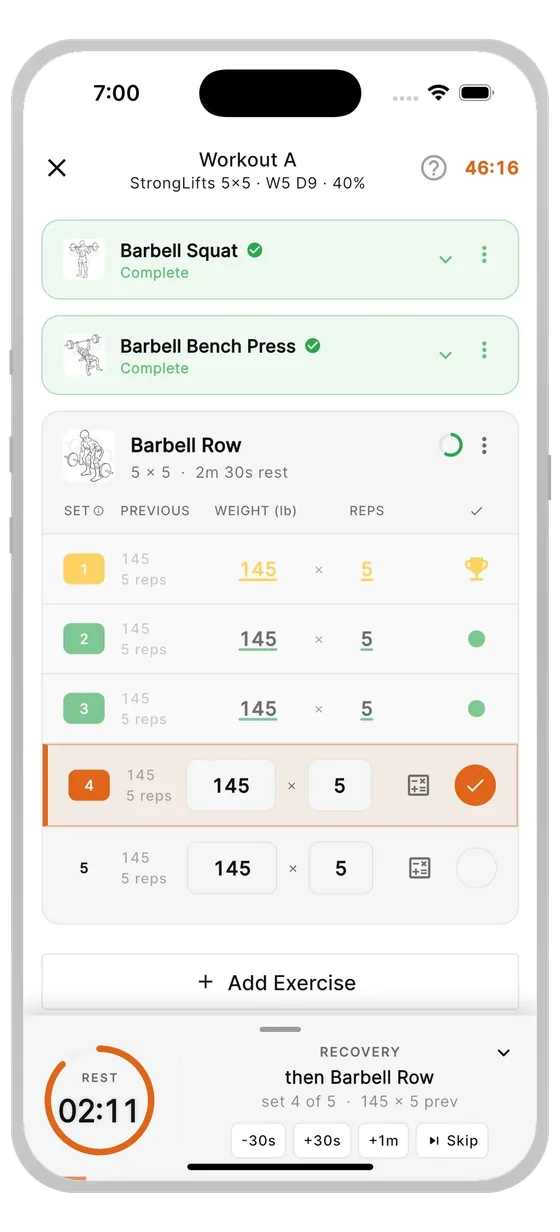
Log an optional RPE with any set and Massiv turns your working sets into an estimated 1RM you can watch over time, plus a rating for the whole session. On exercises that progress by adding sets, hitting your reps with your hardest working set at RPE 8 or easier adds a set next time. Automatic progression is free for your first 30 days.


What RPE means in lifting
RPE stands for rating of perceived exertion. In strength training it's a 1–10 score for how hard a set was, and the version most lifters use counts the reps you had left: RPE 10 means you couldn't have done another rep, RPE 9 means one more was there, RPE 8 means two. Powerlifting coach Mike Tuchscherer of Reactive Training Systems popularized this reps-based scale and the percentage chart that goes with it.
The useful part is that RPE turns a feeling into a number you can plan with. A program can say "3 reps at RPE 8" instead of "3 reps at 85%", and the load adjusts to how strong you are that day.
RPE vs RIR
RIR — reps in reserve — is the same idea counted the other way. Instead of rating the set, you count how many good reps you left in the tank. For the top of the scale they map one to one: RPE = 10 − RIR.
| RPE | RIR | What it feels like |
|---|---|---|
| 10 | 0 | Max effort. No more reps, no more weight. |
| 9.5 | 0–1 | No more reps, but you could have added a little weight. |
| 9 | 1 | One more rep was there. |
| 8.5 | 1–2 | One more for sure, maybe two. |
| 8 | 2 | Two more reps in the tank. |
| 7.5 | 2–3 | Two more for sure, maybe three. |
| 7 | 3 | Fast, solid reps with three to spare. |
| 6.5 | 3–4 | Comfortably submaximal. |
Below about RPE 6.5 the scale gets hard to judge and the chart stops — those sets are warm-ups and technique work, not something to estimate a max from.
RPE chart
Each cell is the percentage of your 1RM you can lift for that many reps at that RPE. Find your reps in the left column and your RPE across the top. Example: 5 reps at RPE 8 is 81.1%, so a 225 lb set of 5 at RPE 8 points to a 1RM of about 277 lb (225 ÷ 0.811).
| Reps | RPE 100 RIR | RPE 9.50–1 RIR | RPE 91 RIR | RPE 8.51–2 RIR | RPE 82 RIR | RPE 7.52–3 RIR | RPE 73 RIR | RPE 6.53–4 RIR |
|---|---|---|---|---|---|---|---|---|
| 1 | 100% | 97.8% | 95.5% | 93.9% | 92.2% | 90.7% | 89.2% | 87.8% |
| 2 | 95.5% | 93.9% | 92.2% | 90.7% | 89.2% | 87.8% | 86.3% | 85% |
| 3 | 92.2% | 90.7% | 89.2% | 87.8% | 86.3% | 85% | 83.7% | 82.4% |
| 4 | 89.2% | 87.8% | 86.3% | 85% | 83.7% | 82.4% | 81.1% | 79.9% |
| 5 | 86.3% | 85% | 83.7% | 82.4% | 81.1% | 79.9% | 78.6% | 77.4% |
| 6 | 83.7% | 82.4% | 81.1% | 79.9% | 78.6% | 77.4% | 76.2% | 75.1% |
| 7 | 81.1% | 79.9% | 78.6% | 77.4% | 76.2% | 75.1% | 73.9% | 72.3% |
| 8 | 78.6% | 77.4% | 76.2% | 75.1% | 73.9% | 72.3% | 70.7% | 69.4% |
| 9 | 76.2% | 75.1% | 73.9% | 72.3% | 70.7% | 69.4% | 68% | 66.7% |
| 10 | 73.9% | 72.3% | 70.7% | 69.4% | 68% | 66.7% | 65.3% | 64% |
Values: the Reactive Training Systems (Mike Tuchscherer) RPE chart, as reproduced by rpecalculator.com and sensai.fit. We checked every cell above against both in October 2026.
How to read it
The chart is one sequence of percentages laid out in a grid. What matters is how far the set was from a max effort: reps done plus reps in reserve. That's why 5 reps at RPE 8 and 7 reps at RPE 10 share the same 81.1% — both are sets where 7 reps was the limit. Moving one column right (half an RPE point easier) or one row down (one more rep) takes you further from a max, so the percentage drops.
How the calculator works
Step 1 divides the weight by the chart percentage: 225 lb × 5 at RPE 8 → 225 ÷ 0.811 ≈ 277.5 lb. Step 2 runs it backwards: if next week calls for 3 reps at RPE 8, that's 86.3% of 277.5 ≈ 239.5 lb, rounded to 240 lb so you can actually load it.
The estimate comes from the RPE chart only, so it won't match a formula-based 1RM calculator exactly — those use Epley, Brzycki or Lombardi and assume the set went to failure. If you run a percentage program like 5/3/1, take the estimate to the training max calculator to set your training max.
When RPE is useful
- Heavy top sets. A single, double or triple "at RPE 8" lets the weight follow your strength on the day, instead of a fixed percentage that's too heavy when you slept badly.
- Back-off sets. Work up to a top set, then drop the load for volume. The chart gives you a sensible starting weight for the drop.
- Spotting fatigue. If the same weight keeps feeling harder week after week, your RPE notes show it before your numbers stall.
- Estimating a max without testing one. A hard triple at a known RPE gives you a usable e1RM with far less fatigue than a true max attempt.
Common RPE mistakes
- Overrating RPE early on. Newer lifters usually have more left than they think and call an RPE 7 a 9. That gives a low estimate and light working weights. An occasional set taken to a true RPE 10 (safely, with a spotter or safeties) recalibrates your sense of effort.
- Using RPE on high-rep sets. Past about 10 reps, burning and breathing make it hard to tell how many reps are left, and the percentages stop being reliable. That's why this chart ends at 10 reps.
- Treating the chart as exact. It's an average. Some lifters can grind out more reps at a given percentage than others, and the same person differs between a deadlift and a bench press. Use the number as a starting point and adjust from how the set moves.
- Rating after the fact. Rate the set right after you rack the bar. Ten minutes later every set feels like it was an 8.
How Massiv uses RPE
In Massiv, RPE is optional on every set you log, and at the end of a workout you can rate the whole session on a five-step scale from easy to maximal. On exercises that progress by adding sets, as in the Push / Pull / Legs program, the app adds a set next time (up to that exercise's set limit) when you hit your reps and your hardest working set was RPE 8 or easier. You can change that threshold in the program builder. A coach note also flags it when your average set RPE has been climbing over the past two weeks.
The app doesn't convert RPE into percentages or set your weights from this chart. Your loads come from your program's progression rules. This calculator uses the standard published chart, so treat it as a planning tool alongside your log.