 MASSIV
FREE TOOL
Max Bench Calculator
Enter a bench press set you actually hit, the weight and how many reps, and see your estimated max bench, your rep maxes and the working weight for every rep range.
Use a real set, not a guess. Estimates are most accurate from a hard set of 1–6 reps taken close to failure. Past 10 reps, treat the number as a ballpark.
Your rep maxes
Derived from the same formulas, in reverse.
| Reps | Weight | % of 1RM |
|---|
MASSIV TRACKS THIS FOR YOU
Your max bench shouldn't need recalculating every week.
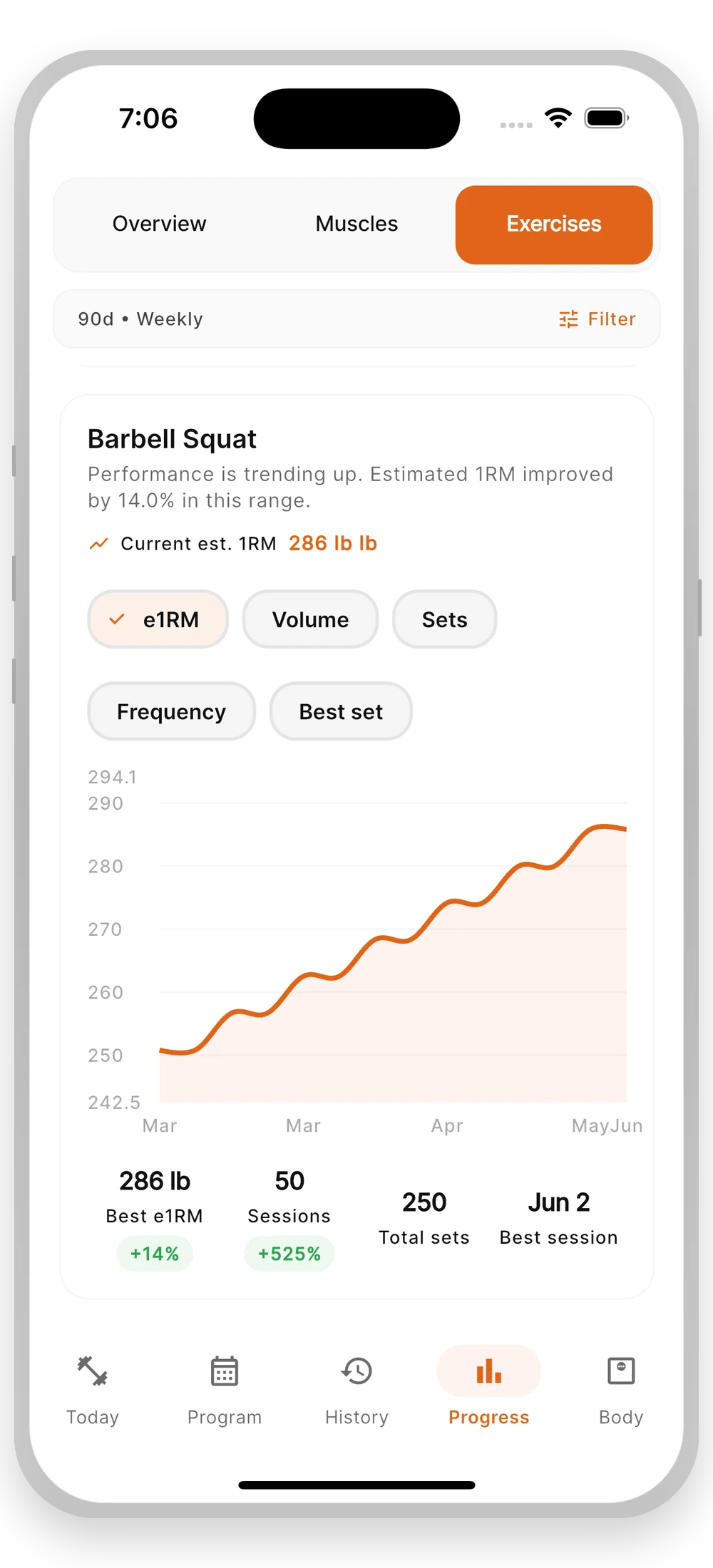
Massiv estimates your e1RM from every working set you log and tracks it as a rolling median of your last four sessions. In programs that run on a training max, it suggests raising the max when your sets outgrow it and shows you why. Automatic progression is free for your first 30 days.


How to calculate your max bench
Your max bench is the heaviest single bench press you can complete with good form. You don't need to test it to know it. Take a recent hard set, say 185 lb for 5 reps, and this calculator scales it up to an estimated one rep max: about 216 lb in that example.
The estimate is most reliable from a set of 2–6 reps taken close to failure. That is why the calculator uses the Epley formula in that range, Brzycki for 7–10 reps and Lombardi above that. It is the same engine as the 1RM calculator for every lift, with bench press defaults and guidance on this page.
Bench press percentage chart
A standard percentage chart based on the Epley formula, so each extra rep takes off a steady amount. For a 185 lb or 85 kg max bench, rounded to the nearest 0.5. Load the closest weight you have; the plate calculator tells you which plates to use.
| Reps | % of max | 185 lb max | 85 kg max |
|---|---|---|---|
| 1 | 100% | 185 lb | 85 kg |
| 2 | 94% | 173.5 lb | 79.5 kg |
| 3 | 91% | 168 lb | 77.5 kg |
| 4 | 88% | 163 lb | 75 kg |
| 5 | 86% | 158.5 lb | 73 kg |
| 6 | 83% | 154 lb | 71 kg |
| 7 | 81% | 150 lb | 69 kg |
| 8 | 79% | 146 lb | 67 kg |
| 9 | 77% | 142.5 lb | 65.5 kg |
| 10 | 75% | 139 lb | 64 kg |
Paused or touch-and-go: it changes the number
A touch-and-go rep uses the rebound off your chest. A paused rep, the powerlifting standard, holds the bar still on your chest before you press. Most lifters pause less weight than they bounce, so an estimate from touch-and-go sets usually reads higher than a paused max. Use the style you train with, and keep it the same when you compare estimates over time.
Testing a true max bench safely
- Use a spotter or safety arms. A failed bench rep can pin you under the bar. Never max out alone without safeties set just below chest height.
- Warm up in steps. Work up through a few lighter sets, for example the bar for 10, then about 50% for 5, 70% for 3, 80% for 2 and 90% for 1.
- Open from the estimate. Make your first attempt around 95% of your calculated max, and only go past 100% if that moved fast.
- Keep the setup the same. Grip width, arch and leg drive all change the number, so test the way you train.
For most lifters, testing isn't necessary at all. An estimate from a hard set of three to five is close enough to program with and costs far less fatigue.
Using your max bench in a program
Percentage programs run off a number derived from your max. 5/3/1 sets a training max at 85–90% of it, and the 5/3/1 calculator turns your max bench into every working weight for the four-week wave. Linear programs like Starting Strength and StrongLifts 5×5 don't need a max at all: you start light and add a small fixed jump each session.
The bench moves slower than the squat and deadlift, so it needs smaller jumps. Every Massiv program steps the bench press by 2.5 kg (5 lb), while most step the squat and deadlift by 5 kg (10 lb), and each target is rounded to the plates you own.
Related tools
1RM calculator
Estimate your one rep max for any lift, with three formulas side by side.
5/3/1 calculator
Turn your max bench into a training max and every weight in the 5/3/1 wave.
RPE calculator
Estimate your max from a set at a given RPE, or find a weight for a target RPE.
Plate calculator
Work out exactly which plates to load on each side of the bar.