 MASSIV
5/3/1 Explained: A Complete Guide for Intermediate Lifters

The 5/3/1 program is the most-run intermediate strength template in the world, and for good reason: it trades the fast, fragile gains of a beginner linear progression for slow, almost boringly reliable progress you can sustain for years. If your newbie gains have dried up and adding weight every session has stopped working, 5/3/1 is built for exactly that moment. This guide covers what the program is, how the math actually works — training max, the four-week wave, AMRAP sets, and the deload — the mistakes that quietly stall people, and how to run it without a spreadsheet.
What is the 5/3/1 program?
5/3/1 is a percentage-based strength program created by powerlifter Jim Wendler. It is organized around the four big barbell lifts — squat, bench press, deadlift, and overhead press — and built on a single principle: progress should be slow enough that you almost never miss a prescribed rep. Instead of chasing a true one-rep max, every working set is calculated from a deliberately conservative number called your training max.
The program runs in repeating four-week blocks. The first three weeks ramp up in intensity; the fourth is a lighter deload. After each block you add a small, fixed amount of weight and start again. That structure is what makes 5/3/1 a wave program: load rises and falls in a cycle rather than climbing in a straight line. The waving is not decoration — periodically backing off lets fatigue dissipate so the next block starts fresh, which is the same logic behind classic periodization research on managing accumulated fatigue.
It is best suited to intermediate lifters: people who can no longer add weight to the bar every single workout but still have years of progress ahead of them. If you are brand new and still adding 5 lb a session, a linear program will grow you faster — come back to 5/3/1 when that stops working.
How 5/3/1 works, step by step
1. Set your training max
Everything in the program flows from your training max (TM), which is set to 90% of your true one-rep max for each lift. If your best bench is 200 lb, your training max is 180 lb, and every percentage below is calculated from that 180 — not the 200.
This feels too light on day one. That is the point. The conservative TM is a buffer that keeps you progressing for months instead of grinding to failure in week three. If you do not know your one-rep max, estimate it from a recent set — an estimated 1RM from, say, 5 reps at 170 lb is close enough to start. Round to a number you can actually load on the bar.
2. Run the four-week wave
Each lift is trained once per week. Every session has three working sets calculated from your training max, and the percentages change week to week in the wave below:
| Week | Set 1 | Set 2 | Set 3 (AMRAP) |
|---|---|---|---|
| 1 — "5s" | 65% × 5 | 75% × 5 | 85% × 5+ |
| 2 — "3s" | 70% × 3 | 80% × 3 | 90% × 3+ |
| 3 — "5/3/1" | 75% × 5 | 85% × 3 | 95% × 1+ |
| 4 — deload | 40% × 5 | 50% × 5 | 60% × 5 |
The percentages are taken from your training max, and weights are rounded to the nearest 5 lb (or 2.5 kg). The "+" on the third set is the most important detail in the whole program.
3. Push the AMRAP / PR set
That last set each week is an AMRAP set — As Many Reps As Possible — also called the PR set. The prescribed number is a minimum, not a target. On week one you must hit at least 5 reps at 85%, but a strong lifter might get 8 or 10. Those extra reps are where the program earns its reputation: they drive hypertrophy through higher total volume and give you an honest, weekly read on whether your training max is set correctly.
Leave 1–2 reps in the tank rather than grinding to true failure. The goal is a hard set with clean technique, not a max-effort single that flattens you for the rest of the week. Track the rep count every time — it is your primary progress signal.
4. Take the deload, then add weight
Week four is intentionally easy: no AMRAP, light percentages, just smooth bar speed to shed fatigue. Do not skip it and do not add reps — its job is recovery, and the science on planned deloads is clear that managing fatigue is what allows the next block to be productive.
After the deload, raise your training max and start the next block: +5 lb for upper-body lifts (bench, overhead press) and +10 lb for lower-body lifts (squat, deadlift). That is roughly 5–10% strength gain per year per lift — modest per block, enormous over time.
Common mistakes (and the FAQ)
Setting the training max too high. The single most common error. People base the TM on a gym-PR they hit once on a good day, the AMRAP sets collapse by week three, and they stall. Start lighter than feels right; the buffer is the feature.
Treating the minimum reps as the target. If you stop the 85% × 5+ set at exactly 5 when you had 9 in you, you leave most of the program's benefit on the floor. Push the AMRAP (while leaving 1–2 in reserve).
Skipping the deload. Week four feels pointless because you are fresh and strong. That is the deload working. Skipping it is how you walk into the next block already fatigued.
Ignoring assistance work. The three main sets are the skeleton, not the whole session. Add push, pull, and single-leg/core assistance (templates like Boring But Big, Triumvirate, or First Set Last) for the volume that drives muscle growth.
Resetting too aggressively after a stall. If your AMRAP reps drop below the minimum on a lift, don't quit the program — drop that lift's training max by ~10% and build back. The wave is designed to absorb exactly this.

How to run it in practice
A standard week is four training days, one per main lift — for example: Day 1 overhead press, Day 2 deadlift, Day 3 bench, Day 4 squat — each followed by assistance work. Three- and two-day variants exist if your schedule is tighter; the wave logic is identical, you just spread the lifts out.
Each session, the workflow is the same: look up the week's three percentages, multiply each by the lift's training max, round to a loadable weight, do your fixed reps on the first two sets, then push the AMRAP and write down the rep count. After four weeks, bump each training max (+5 upper, +10 lower) and repeat. The arithmetic is trivial — it is the consistency of doing it every single session, for every lift, across months, that is genuinely tedious. That tedium is where most lifters drift off the program.
If you're deciding between 5/3/1 and a bodybuilding-style split, it's worth reading PHUL vs PPL — 5/3/1 leans strength-first with hypertrophy assistance, while those splits lead with hypertrophy. Many lifters cycle between them across a training year.
A worked example: one bench cycle
Say your true bench one-rep max is 200 lb. Your training max is 90% of that, so 180 lb — and every weight below comes from 180, rounded to the nearest 5 lb:
| Week | Set 1 | Set 2 | Set 3 (AMRAP) |
|---|---|---|---|
| 1 — 5s | 117 lb × 5 | 135 lb × 5 | 155 lb × 5+ |
| 2 — 3s | 125 lb × 3 | 145 lb × 3 | 160 lb × 3+ |
| 3 — 5/3/1 | 135 lb × 5 | 155 lb × 3 | 170 lb × 1+ |
| 4 — deload | 70 lb × 5 | 90 lb × 5 | 110 lb × 5 |
If you hit 8 reps on that week-one 155 lb set, your training max is well placed — there's room to keep progressing. If you barely scrape the prescribed minimum, your TM is too high and you should reset it down ~10%. After the deload, your bench training max goes to 185 lb and the whole table recalculates. Run that across a year of blocks and the training max climbs from 180 toward roughly 240 — a real, banked strength gain rather than a one-off gym PR.
Choosing your assistance work
The three main sets build strength; assistance builds the muscle that supports it. Wendler's published templates give you a structure so you don't have to invent one:
- Boring But Big (BBB): after your main sets, 5 sets of 10 on the same lift (or its opposite) at 50–60% of the training max. The highest-volume option — best for size, hardest to recover from.
- The Triumvirate: the main lift plus exactly two assistance movements, 5 sets each. Simple and time-efficient.
- First Set Last (FSL): repeat your first working-set weight for several back-off sets. A moderate middle ground between strength and volume.
Whichever you pick, keep assistance organized around push, pull, and single-leg/core so the whole body gets covered across the week. Don't let assistance bury your main lifts — if it leaves you too fried to push the next AMRAP, cut it back.
A few more common questions
How long should I rest between the main sets? Three to five minutes. These are heavy, low-rep sets; full recovery between them protects bar speed and rep quality on the AMRAP.
Can I run 5/3/1 three days a week? Yes. Rotate the four lifts across whatever days you train rather than forcing four sessions. The wave and percentages don't change; the cycle just takes a little longer in calendar time.
What if I miss the minimum reps on the week-three single? One missed block on one lift isn't a failure of the program — drop that lift's training max ~10% and rebuild. Recurrent misses across several lifts usually mean your starting training maxes were set from numbers you can't reliably hit.
How Massiv handles this for you
The 5/3/1 program is simple to understand and tedious to administer: 90% training maxes, three percentages per lift per week, rounding to what you can actually load, the weekly AMRAP log, and the +5/+10 bump after every deload. Massiv ships 5/3/1 as a built-in program and runs all of it for you — it sets and tracks each training max, shows today's exact working weights rounded to your available plates, records your AMRAP reps as your progress signal, and advances the whole cycle automatically when a block ends. You lift; the app moves the bar up.
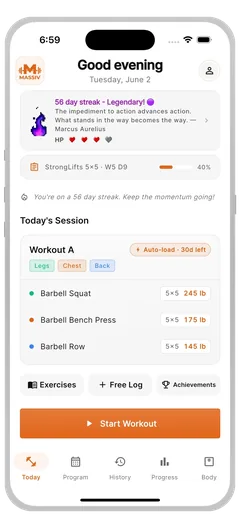
Massiv runs the progression math for this program automatically. Download Massiv and put it to work in the gym.
Download Massiv →5/3/1 works because it is patient: a conservative training max, a hard AMRAP set each week, a real deload, and a small bump every block. Do that honestly for a year and the numbers take care of themselves. The hard part was never the math — it's running it without cutting corners, week after week.