 MASSIV
Deload Week: What It Is, When and How to Deload
A deload week is a planned week of lighter training — fewer sets, lighter weights, or both — that lets accumulated fatigue clear so your strength can show again. You keep training on your usual days with your usual exercises; you just do noticeably less. Most lifters who use them deload for about a week every four to six weeks of hard training, or whenever a lift has stalled for several sessions in a row. This guide covers what a deload is (and isn’t), the signs you need one, exactly how to deload, and how the programs in Massiv build deloads and resets in for you.
What is a deload?
A deload is a short period of reduced training stress meant to shed physical and mental fatigue, help you recover, and leave you better prepared for the next block of hard work. That is roughly how an international panel of strength and physique coaches defined it in a 2023 consensus study. In practice it means one lighter week inside an otherwise normal training schedule.
Two things a deload is not:
- It isn’t a week off. You still go to the gym and still do the same lifts. Rest weeks have their place, but a deload keeps the movement practice and routine going.
- It isn’t a test week. Lighter weights are the point. Turning the deload into a chance to chase a new max defeats it.
Why deload? Fatigue, not lost gains
Hard training does two things at once: it builds fitness, and it piles up fatigue. Fatigue hides fitness. After several weeks of heavy work your joints ache, the bar moves slower, and weights you handled easily a fortnight ago start to grind — not because you got weaker, but because you are carrying more fatigue than a normal rest day clears.
A deload drops the fatigue faster than it drops the fitness, so the strength you have built becomes visible again and the next block starts from a fresher place. That is also why deloads aren’t “losing gains”. In one 2024 study, trained lifters who took a full week completely off in the middle of a nine-week program showed similar lower-body muscle growth to those who trained straight through (the continuous group did gain a little more lower-body strength). A deload is milder than a week off — you are still lifting — so a single lighter week is not where your progress goes to die.
The honest caveat: deloading is near-universal among strength and physique athletes, but direct research on how and when to deload is still thin. Most of what follows is established practice, not settled science.
Signs you need a deload
- A lift has stalled. You have missed reps at the same weight two or three sessions in a row despite sleeping and eating normally.
- Warm-ups feel heavy. Weights that should fly feel like work, and bar speed is down across the board.
- Joints and tendons are complaining. Elbows, knees or shoulders ache in a way that lingers between sessions — different from normal muscle soreness.
- Soreness isn’t clearing. You start sessions still sore from the last one.
- You dread training. Motivation has dropped for no outside reason, and sleep may be worse too.
- It’s been a long time. You have trained hard for six to eight weeks or more without any lighter week.
One bad day isn’t a sign. Several of these together, over a week or two, usually are.
How to deload
There are two main levers — volume and intensity — plus effort. You can pull one or combine them:
| Approach | What changes | Example |
|---|---|---|
| Cut volume | Fewer sets (and sometimes fewer reps); load stays roughly the same | 5×5 at 100 kg → 2–3×5 at 100 kg |
| Cut intensity | Lighter weights; sets and reps similar | 5×5 at 100 kg → 5×5 at 70–80 kg |
| Cut both | Fewer sets and lighter weights | 5×5 at 100 kg → 3×5 at 80 kg |
| Cut effort | Stop every set well short of failure | Finish each set with 3–4 reps clearly left in the tank |
A common rule of thumb is to cut your weekly sets by roughly 40–60% and stop sets well short of failure, either keeping the weight about the same or lowering it. Cutting volume suits strength lifters who want to keep the feel of heavy weights; cutting load suits anyone whose joints are the problem. When in doubt, do both moderately — it is hard to get a deload wrong by making it a bit too easy.
Keep the rest of the week normal:
- Length: about one week. In a 2024 survey of 246 competitive strength and physique athletes, the average deload lasted about 6 days and came roughly every 5–6 weeks.
- Frequency and exercises: train on your usual days and keep the same lifts. The same survey found athletes cut volume, load and effort but kept training frequency and exercise selection largely unchanged.
- Afterwards: go straight back into normal training. Don’t restart from scratch — pick up where the program says you should be.
Planned vs reactive deloads
There are two ways to decide when to deload, and coaches use both:
- Planned (proactive). The deload is written into the program ahead of time — for example, every fourth week. You take it whether you feel beaten up or not, which stops fatigue from building up unnoticed. This is the norm for intermediate programs built on multi-week waves, like 5/3/1.
- Reactive (autoregulated). You deload when the signs show up — usually a stalled lift. Beginner linear programs work this way, and they do it per lift: only the lift that stalled gets lighter, and the others keep climbing.
Neither is “right”. Beginners recover fast enough that a scheduled lighter week mostly wastes progress, so they reset lifts as needed. Intermediates accumulate fatigue more slowly and steadily, so a scheduled lighter week catches it before it turns into a stall. Many lifters combine the two: a planned deload every few weeks, and an early one if things go sideways.
How the programs in Massiv deload
Every structured program handles this differently. Here is exactly what Massiv’s built-in versions do:
| Program | Type | What happens |
|---|---|---|
| Massiv Hypertrophy Waves (5/3/1-style) | Planned | Week 4 of every wave is the deload: main lifts drop to 40%, 50% and 60% of your training max for 5 reps each. The 5×10 supplemental sets stay at the same weight. |
| Massiv Wave: Powerbuilding | Planned | Week 4 is a lighter week: main-lift percentages drop about 15 points below week 3 (squat and bench to 70% of training max, deadlift 75%, overhead press 65%) with the same sets and reps. Accessories keep their own progression. |
| StrongLifts 5×5, Starting Strength, Greyskull LP | Reactive, per lift | No scheduled deload. If you miss reps on a lift in three sessions in a row, that lift’s weight drops by 7.5% (for example, 100 kg → 92.5 kg), rounded to plates you can load, and you build back up. |
| GZCLP | Reactive, per lift | Three failed sessions move a lift from 5×5 to 6×3 at the same weight; three more move it to 10×1. Only when 10×1 stalls does the weight drop 7.5%, and the lift goes back to 5×5. |
A few details matter here:
- Wave programs raise the training max after the deload, not before it: 2.5 kg on most main lifts and 5 kg on the deadlift once the lighter week is done. See the 5/3/1 guide for why the bump comes after the easy week.
- In the linear programs, a session counts as missed when any working set falls short of its target reps — in Greyskull LP, that includes getting fewer than 5 reps on the final AMRAP set. A missed session followed by a successful one resets the count.
- Original rules vary. StrongLifts’ own guidance is a 10% deload after three failed sessions; Massiv’s default cut is slightly smaller at 7.5%. And Massiv’s built-in GZCLP uses a 5×5 → 6×3 → 10×1 ladder, while the current official version runs 5×3 → 6×2 → 10×1 and then a retest — our GZCLP guide describes the official ladder.
If you are running a beginner program and the same lift keeps cycling through resets without ever beating its old best, that is usually the sign to move to a program with a planned deload. The program library shows where each one fits.
Let your program handle the lighter weeks. Massiv applies these rules for whichever program you run: the planned deload week in wave programs, and a lighter reset after repeated misses in linear ones. Automatic progression is free for your first 30 days.
Get Massiv →Coming back after time off
A break from training — illness, travel, a busy month — is a different situation from a stall. You haven’t built up fatigue; you have lost a little conditioning. The fix is the same shape, though: start lighter and climb back quickly. If you come back to Massiv after two weeks or more away, it offers to lower your working weights by an amount that scales with how long you were gone (capped at 15%), and you can accept or skip it.
Common mistakes
- Skipping it because you feel fine. Planned deloads work partly because you take them before you need them. Feeling good in week 4 is often the deload of the previous cycle doing its job.
- Testing maxes during the deload. A lighter week with a max attempt bolted on isn’t a lighter week.
- Adding “just a bit” of extra work. Extra sets, extra exercises or a new conditioning plan quietly turn the deload back into a normal week.
- Deloading every time training feels hard. Hard training is supposed to feel hard. A deload every two weeks usually means the program is too aggressive or recovery outside the gym needs work.
- Resetting the whole program for one stalled lift. On a linear program, only the lift that stalled needs to get lighter.
Common questions
What is a deload week? A deload week is a planned week of lighter training — fewer sets, lighter weights, or both — that lets accumulated fatigue clear so you can keep progressing. You keep your usual training days and exercises; you just do noticeably less work and stop every set well short of failure.
How often should you deload? Many lifters deload for about one week every four to six weeks of hard training, either on a fixed schedule or when lifts stall. Beginners on linear programs usually don’t need scheduled deloads; they reset individual lifts after repeated misses instead.
Should I cut volume or weight during a deload? Either works. A common approach is to cut weekly sets by roughly 40–60% while keeping the weight similar, or to keep sets similar and use clearly lighter weights. If joints are the problem, lower the weight; if you want to keep the feel of heavy loads, cut sets instead.
Will I lose muscle or strength during a deload? It is unlikely. A deload is a single lighter week, not a layoff. In a 2024 study, even a full week completely off in the middle of a nine-week program led to similar lower-body muscle growth as training straight through; the continuous group gained slightly more lower-body strength. A deload, where you keep lifting, is a much gentler change than a week off.
How Massiv handles this for you
Deloads are easy to agree with and easy to forget. Planned ones need you to know which week of the wave you are in and what the lighter percentages work out to on the bar; reactive ones need you to notice that a lift has been missed three sessions running. Massiv tracks both. In wave programs it labels the lighter week, calculates every deload weight from your training max and rounds it to your plates; in linear programs it counts misses per lift, applies the program’s reset, and tells you which rule fired. Automatic progression — including these resets — is free for your first 30 days.
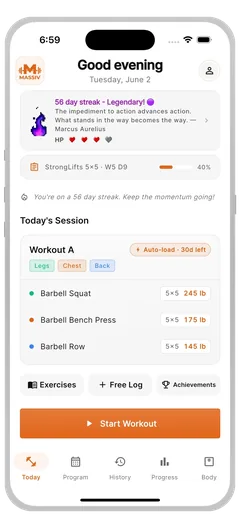
Massiv works out your deload weights and resets stalled lifts for you, so you never calculate the lighter weights yourself. Automatic progression is free for your first 30 days. Download Massiv and put it to work in the gym.
Download Massiv →A deload is the least glamorous week of training and one of the most useful. Train hard, back off for a week before fatigue buries your progress, then build again from a fresher start. Pair it with steady progressive overload and a program that schedules both, and the lighter weeks pay for themselves.