 MASSIV
Greyskull LP: Linear Progression With AMRAP Sets

Greyskull LP is John Sheaffer's take on beginner linear progression, and it changes one thing about the standard template: the last set of every lift goes for as many reps as you can manage with good form. That single modification — the AMRAP set — turns a fixed program into one that reads how strong you feel that day. This guide covers the two sessions, how the AMRAP drives progression, and when it beats a strict 3×5.
The two sessions
Like most linear programs it alternates two full-body workouts across three days a week. The final set of each lift is the AMRAP — written here as 5+.
| Session A | Session B |
|---|---|
| Bench press — 2×5, 1×5+ | Overhead press — 2×5, 1×5+ |
| Squat — 2×5, 1×5+ | Squat — 2×5, 1×5+ |
| — | Deadlift — 1×5+ |
Greyskull also leaves deliberate room for "plug-in" accessory slots — chin-ups, rows, arm work — which is part of why people who care about how they look as well as what they lift tend to prefer it.
What the AMRAP set actually does
On a strict 3×5 you stop at fifteen total reps whether the last set was a grind or a warm-up. Greyskull removes that ceiling. On a good day you might get ten or twelve reps on your last bench set; on a bad day you get six. Both outcomes are useful information, and both are more training than stopping at five would have been.
That has two effects. It autoregulates — hard days do not become harder, good days are not wasted. And it adds volume exactly where volume is cheap: the last set, at a weight you have already proven you can handle for five.
How progression works
You still add weight every session — 2.5 kg / 5 lb on upper-body lifts, 5 kg / 10 lb on lower — but the AMRAP result decides what happens when things get hard. Hit five or more on the last set, with the earlier sets complete, and you progress as normal. In the original program, falling short means resetting that lift by roughly 10% and climbing again. Massiv's built-in version is more patient: a session where any set comes up short of five holds the weight, and only three such sessions in a row reset the lift, by 7.5%.
Some versions use a double-progression rule on top: clear a high rep target on the AMRAP — say ten — and take a bigger-than-normal jump. That is optional, and worth adding only once the standard increments start to slow. Massiv applies a version of it automatically: seven or more reps on the last set doubles the next jump.
Greyskull vs Starting Strength vs StrongLifts
- Starting Strength — 3×5, no AMRAP, lowest volume, most direct route to a heavy squat.
- StrongLifts 5×5 — highest volume of the three, 25 reps per lift, and the one most likely to stall on recovery rather than strength.
- Greyskull LP — between the two, with the AMRAP doing the work that a fixed rep scheme cannot: adjusting to the day you are actually having.
If you have already run one of the other two and want a second linear block without repeating yourself, Greyskull is the usual answer.
Common mistakes
- Taking the AMRAP to genuine failure every session. It is "as many reps as possible with good form," not a max-out. When form breaks, the set is over.
- Adding weight after a three-rep AMRAP. If you did not clear five, the weight was too heavy — that is the signal to hold the weight or reset, not to push.
- Loading the plug-in slots too early. Accessories are there to be added when the main lifts are still moving easily, not to rescue a stalling program.
How Massiv handles this for you
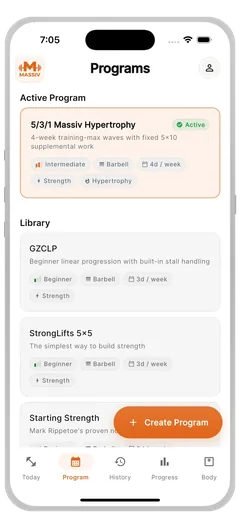
Greyskull LP is one of Massiv's 17 built-in programs, with the AMRAP last set part of the prescription rather than something you track on the side. The built-in version covers the main lifts only; it doesn't include the plug-in accessory slots. The app records the reps you hit on every set: complete them all and the weight goes up next session, and if the last set reaches seven or more, the jump is doubled.
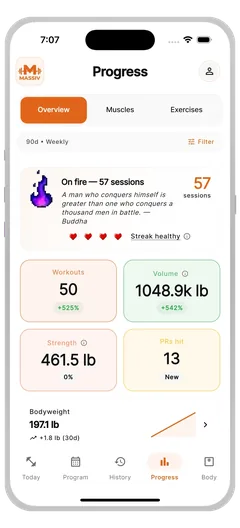
That is the part that is genuinely tedious by hand. An AMRAP program only works if something remembers that you hit nine reps on bench two sessions ago and six last time — because the trend across those numbers, not any single set, is what tells you whether to keep adding weight or to reset. Massiv keeps that history per lift, holds the weight after a session that comes up short, and takes 7.5% off after three short sessions in a row. The workout summary tells you when a lift resets and to what weight.
Automatic progression — including these resets — is free for your first 30 days; after that it is part of Pro, and you can keep running any program manually without it.
The AMRAP set is only useful if something tracks it. Massiv runs Greyskull LP and reads the result for you.
Get Massiv free →Source
Greyskull LP comes from John Sheaffer (Johnny Pain) and is set out in The Greyskull LP. This guide covers how the progression works and how Massiv runs it; the author's own material is authoritative, and is available from Greyskull Nation. Massiv is not affiliated with or endorsed by Greyskull.
Common questions
Is Greyskull LP better than Starting Strength? It is not strictly better, it is more forgiving. The AMRAP set means a bad day costs you less and a good day gives you more, which suits people whose sleep and stress vary week to week. For a pure, fastest-possible strength run with a coach watching your form, Starting Strength is still hard to beat.
How many reps should I get on the AMRAP set? Five is the minimum that keeps the progression going. Anywhere from five to about ten is normal; if you are regularly hitting twelve or more, the weight has fallen behind and you should take a bigger jump. In Massiv, a last set of seven or more doubles the next jump automatically.
Can I add arm work? Yes — that is what the plug-in slots are for. Add them while the main lifts are still progressing, and drop them first if progress slows.
Greyskull LP with the AMRAP tracking and resets handled. Free to download on iPhone and Android, no account required.
Download Massiv →Greyskull LP is the linear program for people who do not have identical days. Push the last set for what the day gives you, add the small weight, reset when five stops happening — and let the AMRAP do the autoregulation that a fixed rep scheme cannot.