 MASSIV
Starting Strength: The Complete Beginner Guide

Starting Strength is the barbell program most people are pointed at first, and for good reason: three sessions a week, three exercises a session, and more weight on the bar every single workout. Mark Rippetoe built it on the idea that untrained lifters progress fastest when training is simple and hard, not varied and clever. This guide covers how the two workouts alternate, how fast to add weight, what to do when it stops working, and how long you can expect to ride it.
The two workouts
There are only two sessions, and you alternate them three days a week with a rest day between each — Monday, Wednesday, Friday is the usual layout. Squat appears in both.
| Session A | Session B |
|---|---|
| Squat — 3×5 | Squat — 3×5 |
| Bench press — 3×5 | Overhead press — 3×5 |
| Deadlift — 1×5 | Deadlift — 1×5 |
Run them A, B, A then B, A, B the following week, so nothing lands on the same weekday twice in a row. Warm-up sets sit outside the prescription: the 3×5 refers to work sets only.
How the progression works
You add weight every workout, not every week. In practice that means a small jump on each lift each time it comes round:
- Squat and deadlift: roughly 5 kg / 10 lb per session at the start, dropping to 2.5 kg / 5 lb once the bar gets heavy.
- Bench and overhead press: 2.5 kg / 5 lb per session, and the press will slow before anything else does — it is the smallest lift with the least muscle behind it.
The increments are supposed to feel almost trivially small at the beginning. That is the point: the program is not trying to make each session maximally hard, it is trying to make the next hundred sessions possible. If you can only make the jump by grinding, the jump was too big.
Picking your starting weights
Start lighter than your ego wants. The standard advice is to begin with a weight you could do for eight clean reps and work up from there, which usually means the empty bar for the presses and something close to it for the squat. You will be adding weight three times a week — a start that feels too easy is erased inside a fortnight, while a start that is too heavy costs you the whole linear run.
When it stalls — and it will
Linear progression ends for everyone. The standard reset is: miss reps on a lift in two consecutive sessions, drop that lift by 10%, and work back up. The lighter weeks let you re-approach the sticking point with a bit more accumulated strength behind you.
You can usually reset a lift two or three times before the resets stop buying you anything. When that happens the program has done its job and it is time to move to something with a weekly rather than session-to-session structure — the Texas Method is the classic next step, and Greyskull LP is a gentler option if you want to keep a linear feel with AMRAP sets layered on.
Common mistakes
- Adding exercises. Curls and lateral raises are not the reason the program works, and the extra fatigue makes the squat progression harder. Add accessories after the linear run ends, not during it.
- Skipping the deadlift because it's heavy. One work set is already the lowest volume in the program.
- Missing sessions. Three a week is the dose. Two a week turns a twelve-week program into an eighteen-week one.
- Rounding your own weights. If your gym's smallest plate is 2.5 kg per side, you cannot make a 2.5 kg total jump without microplates. Know your smallest possible increment before you plan the run.
How long does it last?
Most people get somewhere between eight and sixteen weeks of genuine linear progress, and lighter or younger lifters often get more. The end is not a failure state — it is the transition from "beginner" to "intermediate," which is really just a statement about how quickly you can recover from a hard session.
How Massiv handles this for you
Starting Strength is built into Massiv, so the alternating A/B schedule, the 3×5 and 1×5 prescriptions, and the per-session increments are already set up. The app carries your working weights forward, so the next session opens with the exact target rather than a blank field you fill from memory.
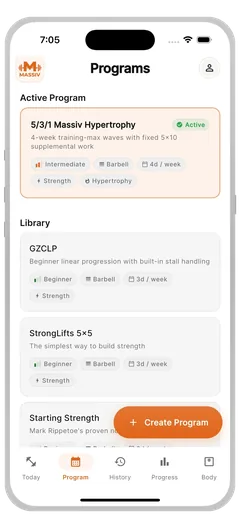
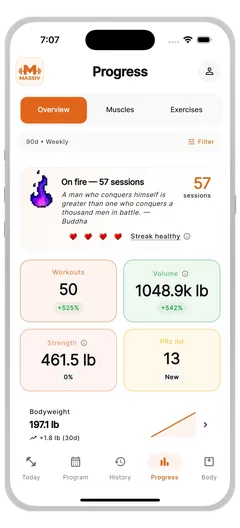
Two things it takes off your plate specifically. First, every prescribed weight is rounded to plates you actually own — set your bar and plate inventory once and you never get a target you cannot load. Second, when you miss reps in two consecutive sessions, the 10% reset is applied for you and labelled with the rule that triggered it, so the end of your linear run is something you are told about rather than something you notice three weeks late.
Run Starting Strength with the increments, resets and plate math already handled.
Get Massiv free →Source
Starting Strength is Mark Rippetoe's program, set out in full in the book of the same name. This guide describes how the method works and how Massiv runs it; for the author's own instruction — particularly on lifting technique, which no article can teach — see startingstrength.com. Massiv is not affiliated with or endorsed by Starting Strength.
Common questions
Is Starting Strength good for beginners? It is one of the most proven beginner barbell programs there is, provided you can practise the lifts three times a week and are willing to focus on technique over load early on. Its low exercise variety is a feature for a beginner and a limitation later.
How is it different from StrongLifts 5×5? StrongLifts runs 5×5 on the main lifts and includes rows; Starting Strength runs 3×5 with lower total volume and no rows, relying on the deadlift for pulling. Starting Strength is slightly harder per set and easier to recover from overall.
Can I run it three days a week with weekends off? Yes — Monday, Wednesday, Friday is the standard layout. What matters is the rest day between sessions, not which days you pick.
Every increment, reset and plate calculation, handled. Free on iPhone and Android, no account required.
Download Massiv →Starting Strength is a short program by design. Run it honestly, add the small weight every session, reset when you have to, and get off it when the resets stop working — that whole arc is the beginner phase, and it is the fastest strength you will ever gain.