 MASSIV
Progressive Overload Explained
If there’s one principle that separates training that works from going to the gym and lifting random weights, it’s progressive overload. Every effective program — 5×5, 5/3/1, PPL, all of them — is just a different way of organizing it. This guide explains what progressive overload actually means, the five levers you can pull to apply it, the practical method most lifters should use, and how fast to push at each stage.
What is progressive overload?
Progressive overload is the gradual increase of stress placed on your body during training over time. Your muscles, bones and nervous system adapt to the demand you put on them; once they’ve adapted, that same demand no longer forces change. To keep progressing, the demand has to keep rising. Do the exact same workout — same weight, same reps — for months and your body has no reason to get bigger or stronger. It already handles that load.
The word that matters is gradual. Overload that’s too aggressive outruns your ability to recover and leads to missed reps or injury; too little and nothing changes. The art of programming is dosing the increase just right.
The five ways to apply it
Adding weight to the bar is the most obvious lever, but it’s not the only one. There are five:
| Lever | What you increase | Example |
|---|---|---|
| Load | Weight on the bar | 100 lb → 105 lb for the same reps |
| Reps | Reps at the same weight | 3×8 → 3×10 at 100 lb |
| Sets | Total volume | 3 sets → 4 sets of the same lift |
| Tempo / ROM | Time under tension, range of motion | Slower negatives; deeper squat |
| Density | Work per unit of time | Same work with shorter rest |
Load and reps are the two big ones — the others are useful when you can’t add weight or reps any further. You don’t push all five at once; you pick one or two and hold the rest steady so you actually know what drove the progress.
The practical method: double progression
Adding weight every session works for a beginner and then stops. The method that works for almost everyone, almost forever, is double progression — you progress reps first, then weight:
- Pick a rep range for the exercise — say 8–12.
- Keep the weight the same until you can do the top of the range (12) for all your sets.
- Then add the smallest increment available (2.5–5 lb), and drop back to the bottom of the range (8).
- Climb the reps back up to 12, add weight, repeat.
It’s called double progression because you’re progressing two variables in turn — reps, then load. It gives you a built-in runway between weight jumps, which is exactly what makes it sustainable past the beginner phase.
How fast should you push?
It depends entirely on training age:
- Beginners can often add weight every session for months — linear progression. Recovery is fast and adaptation is dramatic. Ride it.
- Intermediates need to slow down to weekly or monthly progress — this is where double progression and programs like 5/3/1 take over.
- Advanced lifters may add weight to a lift only a few times a year, and lean more on the other levers (volume, density, tempo) to keep nudging adaptation.
The mistake is pushing at a beginner’s pace forever. Progress that comes weekly instead of per-session isn’t slower progress — it’s the only kind that lasts once the newbie phase ends.
Common mistakes
- Not tracking. You can’t progressively overload what you don’t measure. If you don’t know last week’s numbers, you’re guessing — log every set.
- Adding weight at the cost of form. Reps with broken technique or chopped range aren’t progress; they’re a different, easier exercise. Honest reps only.
- Pushing too many levers at once. More weight and more sets and less rest, all in one week, is how you bury yourself. Change one thing.
- Never backing off. Overload needs recovery to turn into adaptation. Deloads aren’t lost progress — they’re what lets the next push land.
- Ego-loading. A weight you can’t control isn’t overload, it’s a near-miss waiting to happen.
How programs build it in for you
You don’t have to invent your own overload scheme — that’s what programs are. StrongLifts 5×5 is pure linear load progression. 5/3/1 encodes it as a conservative training max plus AMRAP sets and monthly bumps. PPL relies on you running double progression on each lift. Each is a recipe for applying this one principle at a sustainable dose — which is why following a real program beats freelancing.
Common questions
What is progressive overload in simple terms? Progressive overload is gradually increasing the stress on your body during training over time — usually by adding weight or reps — so your muscles keep being forced to adapt. Without it, doing the same workout repeatedly stops producing results.
How do I apply progressive overload? The most sustainable method is double progression: pick a rep range, keep the weight fixed until you hit the top of the range on all sets, then add a small increment and drop back to the bottom of the range. You can also progress by adding sets, slowing tempo, increasing range of motion, or shortening rest.
How fast should I add weight? Beginners can often add weight every session; intermediates progress weekly to monthly; advanced lifters may add weight only a few times a year and rely more on volume and density. Pushing at a beginner's pace indefinitely leads to stalls and injury.
How Massiv handles this for you
Progressive overload is simple to state and tedious to manage: you have to remember last session’s weight and reps for every lift, know when you’ve cleared the rep range, and apply the right increment at the right time. Massiv does that bookkeeping for you. Whatever built-in program you run, it tracks every set, knows when you’ve earned a weight bump, and shows today’s targets with the plates to load — so the overload keeps moving without you running a spreadsheet on the gym floor.
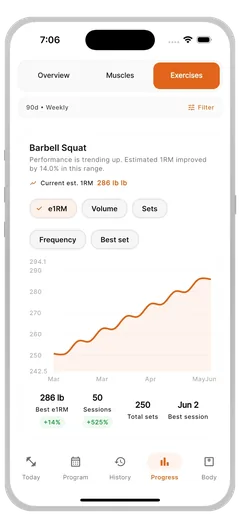
Massiv tracks your numbers and applies progressive overload for you automatically. Download Massiv and put it to work in the gym.
Download Massiv →Progressive overload is the whole game: do a little more, over time, than your body is used to — then recover and do it again. Track your lifts, push one or two levers at a sustainable pace, respect the deloads, and let a real program dose it for you. Everything else in training is a detail on top of this one idea.