 MASSIV
5/3/1 Boring But Big (BBB): The Template Explained
Boring But Big (BBB) is Jim Wendler's highest-volume way to run 5/3/1. Each day you do the normal 5/3/1 sets for one main lift, then 5 sets of 10 on the same lift or its opposite at 50–60% of your training max, then a little lat and ab work. It is usually run four days a week, and the training max goes up every cycle, so the 5×10 weights rise with it.
That is the whole program, and the name is honest about it: there is nothing clever here, just a lot of repetitions with moderate weight on top of a conservative strength wave. This guide covers the weekly layout, how heavy the 5×10 should be, how the separate 3-Month Challenge differs, what assistance and conditioning to add, and the mistakes that make BBB harder than it needs to be. If you have not run 5/3/1 before, start with 5/3/1 explained; this page assumes you know what a training max is.
What Boring But Big is
5/3/1 is built around four barbell lifts: squat, bench press, deadlift and overhead press. Every working weight is a percentage of a training max (TM), a deliberately conservative number below your true one-rep max. Wendler's own training max article calls 90% of your max the recommended starting point, and notes that later books use lower figures such as 85%.
The main 5/3/1 sets build strength but are short: three working sets per lift. Boring But Big is a supplemental template that adds the volume. On Wendler's BBB page, the rule is to do the 5/3/1 program "as you normally would," then add the 5×10. Because the 5×10 is also a percentage of the training max, it gets heavier on its own as the training max goes up.
The BBB week, day by day
Wendler gives two four-day examples and says neither is better; they involve the same amount of work. The first repeats the main lift for the 5×10. The second pairs each main lift with its opposite, so every lift is trained twice a week.
| Day | Main 5/3/1 sets | Option 1: same lift | Option 2: opposite |
|---|---|---|---|
| 1 | Overhead press | Press 5×10 | Bench 5×10 |
| 2 | Deadlift | Deadlift 5×10 | Squat 5×10 |
| 3 | Bench press | Bench 5×10 | Press 5×10 |
| 4 | Squat | Squat 5×10 | Deadlift 5×10 |
Wendler says BBB is best used in a three- or four-day program. The four-day layout above is the standard one. In both examples, the press and bench days finish with lat work and the deadlift and squat days finish with ab work.
The main sets
The main lift follows the normal 5/3/1 wave. These are the commonly published percentages of the training max, with the last set taken for as many reps as you can in standard 5/3/1:
| Week | Set 1 | Set 2 | Set 3 |
|---|---|---|---|
| 1 — 5s | 65% × 5 | 75% × 5 | 85% × 5+ |
| 2 — 3s | 70% × 3 | 80% × 3 | 90% × 3+ |
| 3 — 5/3/1 | 75% × 5 | 85% × 3 | 95% × 1+ |
| 4 — deload | 40% × 5 | 50% × 5 | 60% × 5 |
The free 5/3/1 calculator turns your one-rep max into a training max and prints every main-set weight for the wave.
How heavy should the 5×10 be?
Wendler's general rule is 50–60% of the training max for all five sets. A few details from his BBB page are worth knowing before you load the bar:
- Beginners start lighter. He suggests around 30% for the first cycle, 45% for the second and 60% for the third, then 60% for every cycle after that.
- The sets do not have to be identical. He lists ascending (30/40/50/60/70), descending (70/60/50/40/30) and up/down (50/60/70/60/50) schemes as examples.
- The work matters more than the weight. His emphasis is on completing the 5×10, not on how much is on the bar.
- On the deload week, do the 5×10 or cut it to 3×10, using judgment.
- Variations are allowed. Front squats, safety bar squats, trap bar or deficit deadlifts, incline, close-grip or dumbbell pressing can replace the barbell lift. For dumbbells he says to pick weights by feel rather than by percentage.
The BBB 3-Month Challenge is a different plan
Search results often blend standard BBB with Wendler's Boring But Big 3-Month Challenge. They share the 5×10, but the challenge has stricter rules:
| Standard BBB | 3-Month Challenge | |
|---|---|---|
| Last main set | Push it, as in normal 5/3/1 | Prescribed reps only, no extra reps |
| 5×10 lift | Same lift or opposite lift | Same lift in the sample workouts |
| 5×10 load | 50–60% of TM (beginners ramp 30/45/60) | 50% month 1, 60% month 2, 70% month 3 |
| Days per week | Three or four | Four only |
| Assistance | Lat work and abs | One push, one pull and one ab movement, kept light |
| Conditioning | Matched to your goals and level | Walking (some options with a weight vest) or Prowler pushes |
The challenge also tells you to eat a lot. Running 5×10 at 70% of the training max after your main sets is hard, and it is not designed for a calorie deficit. If you are new to BBB, the standard version with the lighter ramp is the gentler place to start.
Assistance work and conditioning
Standard BBB keeps assistance small on purpose. The examples use lat work on the pressing days and ab work on the lower-body days, and Wendler notes that lat work can be swapped for curls or shrugs. To save time, you can superset the press 5×10 with your lat work.
Conditioning, in his words, should reflect your goals and your training level. The BBB page gives no fixed protocol; the 3-Month Challenge suggests walking or Prowler work several days a week.
A worked example: one squat day
Say your squat training max is 300 lb. On week one of the wave, a standard BBB squat day looks like this:
| Block | Prescription | Weight |
|---|---|---|
| Main sets | 65% × 5, 75% × 5, 85% × 5+ | 195, 225, 255 lb |
| 5×10 at 50% | 5 sets of 10 | 150 lb |
| 5×10 at 60% | 5 sets of 10 | 180 lb |
| Assistance | Ab work | Your choice |
Pick either 150 lb or 180 lb for the 5×10, not both. In the 3-Month Challenge, the third month at 70% would put the same lifter at 210 lb for 5×10.
When to raise the training max
The common 5/3/1 progression is to raise the training max after each cycle: about 5 lb (2.5 kg) for upper-body lifts and 10 lb (5 kg) for lower-body lifts. Because the 5×10 is a percentage of the same number, the supplemental weights climb with it. Wendler's training max article also makes the point that the training max is a tool you adjust, not a number you chase. If the main sets start to grind, lower it.
Sixteen lift-weeks of percentages, done for you. The free 5/3/1 calculator gives you every wave weight from your training max. In Massiv’s 5/3/1-style program, each session’s weights are worked out and rounded to your plates, with the 5×10 ready after your main sets. Automatic progression is free for your first 30 days.
Get Massiv →Common mistakes
- Adding more volume. Wendler calls this the biggest BBB mistake. Five sets of ten after the main work is already a lot. More assistance, extra sets or a second program on top makes it worse, not better.
- Starting the 5×10 too heavy. Lower-body 5×10 can leave you sore for days. If the soreness stops you training the next session, the weight was too heavy. Use the beginner ramp.
- Treating the 5×10 as a test. The goal is to finish all fifty reps with clean technique. Wendler suggests taking the belt off for squat and deadlift 5×10, and starting lighter if you are not used to that.
- Fighting your grip on deadlifts. Straps are allowed for the 5×10 and deadlift work. If 5×10 deadlifts are too taxing, Wendler suggests light good mornings or straight-leg deadlifts instead.
- Mixing up the two versions. Use the challenge's 70% month with standard BBB's AMRAP sets and you get a harder program than either one.
How Massiv's 5/3/1-style program compares
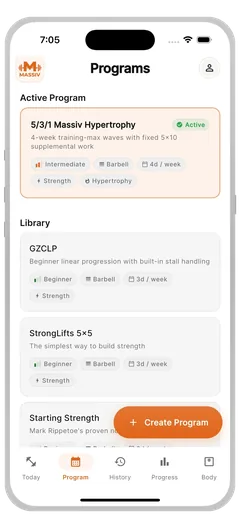
Massiv does not include an official Boring But Big template. Its closest program is Massiv Hypertrophy Waves (5/3/1-style), an independent Massiv adaptation; it is not an official Jim Wendler program. It runs four days a week, rotating squat, overhead press, deadlift and bench through a four-week training-max wave (5/5/5, then 3/3/3, then 5/3/1, then a deload), and adds a fixed 5×10 supplemental block after the main lift.
The 5×10 block is close to BBB in places and different in others:
| Day | Classic BBB | Massiv Hypertrophy Waves |
|---|---|---|
| Squat | Squat 5×10 (or deadlift) | Squat 5×10 at 55% of squat TM |
| Overhead press | Press 5×10 (or bench) | Bench 5×10 at 55% of bench TM |
| Deadlift | Deadlift 5×10 (or squat) | Barbell row 5×10 |
| Bench press | Bench 5×10 (or press) | Overhead press 5×10 at 55% of press TM |
Put simply:
- The 5×10 load is fixed at 55% of the training max. There is no beginner ramp and no 50/60/70 challenge progression.
- Deadlift day uses barbell rows for the 5×10 instead of deadlifts or squats.
- The template has no lat, ab or conditioning work. Add your own if you want BBB-style assistance.
What the app does handle: it holds your training max, works out each week's percentages, rounds every prescribed weight to the bar, plates and dumbbells you own, and raises the training max at the end of the wave. If you want to run Wendler's BBB exactly as written, use his book and the 5/3/1 calculator. If you want a 5/3/1-style wave with 5×10 volume and none of the arithmetic, Massiv's version is the one to try. The best app for 5/3/1 compares other options, including apps with more published 5/3/1 variants.
Common questions
Should the 5×10 be the same lift or the opposite lift? Either works. Wendler gives both options and says neither is better and both involve the same amount of work. Pairing each main lift with its opposite (press with bench, deadlift with squat) trains every lift twice a week.
What percentage should I use for the 5×10? 50–60% of your training max, not your one-rep max. If you are new to that much volume, start near 30% and build to 60% over three cycles. The 3-Month Challenge uses 50%, 60% and 70% in successive months.
Can I run Boring But Big three days a week? Standard BBB, yes: Wendler says it works best in a three- or four-day program. The 3-Month Challenge is written for four days a week only.
Do I do the 5×10 on the deload week? Wendler's answer is to do the 5×10 or cut it to 3×10, using your judgment about how recovered you are.
Want a 5/3/1-style wave with 5×10 volume, without the spreadsheet? Massiv Hypertrophy Waves works out the percentages and rounds them to your plates. Automatic progression is free for your first 30 days.
Download Massiv →Boring But Big works because it is simple enough to keep doing: conservative main sets, fifty moderate reps, a little upper-back and ab work, and a training max that creeps up each cycle. Resist the urge to add more, and give it a few months.