 MASSIV
The Best Wear OS Workout App for Lifting in 2026
Wear OS lifters have few real options — Strong has no Wear OS app at all as of August 2026, and most that exist offer a start button and a heart-rate graph. A genuine Wear OS workout app logs sets from the wrist, shows the next prescribed weight, and keeps your work when the phone connection drops. Massiv is native Kotlin with an on-watch database and an offline queue, free on Wear OS.
That gap is worth understanding before you pick anything, because the feature lists all look similar and the thing that separates these apps is not on them. What follows is what actually matters between sets on a watch, the one failure mode nobody advertises, and two five-minute tests that will tell you more than any store listing.
What makes a Wear OS app good for lifting
Ignore the feature-list checkboxes. These are the things you actually use between sets:
- Logging sets from the watch — mark a set done, adjust reps and weight, move to the next set, without touching the phone. Not a "start workout" button that hands everything back to the phone.
- A rest timer with a haptic buzz — the single most valuable thing a watch does for lifting. A tap on the wrist when rest is up beats staring at a phone counting down.
- Rotary input — the Galaxy Watch bezel or a rotating crown is far faster than tapping small +/− targets with chalky hands.
- Today's prescribed set on the wrist — the target weight and reps, not an empty field you have to remember how to fill.
- Tiles and a complication — one swipe or one tap from the watch face into the session, instead of digging through the app launcher mid-workout.
- Graceful behavior when Bluetooth drops. This is the one nobody advertises and everybody hits. More on it below.
The Wear OS problem nobody puts on the feature list
Almost every Wear OS strength app is a companion: the phone owns the workout, and the watch is a remote control. That is a reasonable design — until the connection drops. Your phone is in a locker, in a bag across the room, or just far enough away that Bluetooth gives up between sets. Now the interesting question is what the watch does with the set you just logged.
Badly built companions do one of two things: they refuse the input outright and make you wait for a reconnect, or — worse — they accept it, then quietly overwrite it the next time the phone pushes its version of the session. You finish your workout, open the phone, and a set is missing. There's no error message, because from the app's point of view nothing failed.
This is worth testing before you commit to an app. It is also worth being honest about what "standalone" means: very few strength apps genuinely run a program on the watch alone, and most that claim it are storing a flat list of sets rather than running your progression.
What to skip
- Automatic rep counting from wrist motion. It demos well and works inconsistently across lifts. Logging a set manually with the bezel takes two seconds and is always right.
- Heart rate as the headline feature. Fine to record, but HR isn't very actionable during heavy resistance work — it's not a reason to pick an app.
- A watch app that's only a timer. If it can't show your plan or log a set, it's a stopwatch with a logo.
How to choose one
Two tests, both take five minutes:
The workflow test. Start a session, log a full set with weight and reps, and start the rest timer — without touching the phone. If any step sends you back to the phone, it isn't really a wrist app.
The airplane-mode test. Start a workout, put the phone in airplane mode, log two sets on the watch, then turn the phone back on. Both sets should appear on the phone. This is the one that separates the field, and most apps fail it — surviving a dropped connection has to be designed into the sync layer from the start, and it can't be bolted on later. Run it before you commit, because otherwise you find out on a PR attempt instead of on a Tuesday.
How Massiv handles this
Massiv's Wear OS app is native Kotlin and Jetpack Compose with its own on-watch database — not a webview or a mirrored phone screen. You get today's session, the prescribed weight and reps for the next set, previous-session values under each set so you know what you did last time, a rest timer with haptics, live heart rate, and a plate calculator on your wrist that rounds to the plates you actually own.
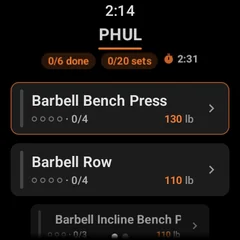
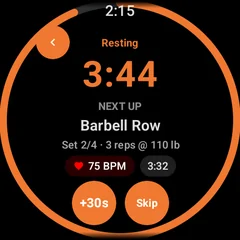
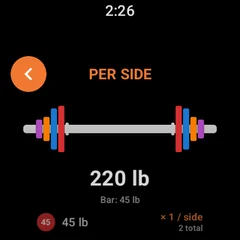
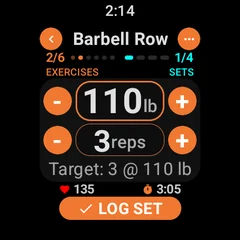
The connection problem is handled at the protocol level rather than hoped away. Every action you take on the watch is written to an on-watch queue before it is sent, tagged with its own ID. The phone acknowledges each one individually, and only an acknowledgement clears it from the queue — so a set logged with the phone out of range stays on the watch until it is confirmed, then flushes automatically on reconnect. When the phone sends back its version of the session, any actions still waiting in the queue are re-applied on top of it. A stale snapshot cannot erase a set you logged offline.
The rest timer syncs as an end timestamp instead of a countdown, so each device works out the remaining time itself. It survives the app being killed, it doesn't drift, and it doesn't need a constant stream of updates to stay accurate.
Massiv runs your program's progression, so the watch shows the right target — not a blank field. Free on Wear OS and Android, no account required.
Download Massiv →What Massiv does not do
Two limits worth stating plainly, because you'd find them yourself in the first week:
- It isn't standalone. The phone owns the workout and the data; the watch is a full-featured client with an offline buffer, not an independent app. You can train through a dropped connection without losing anything, but you can't leave the phone at home.
- There's no Garmin app. Wear OS and Apple Watch only.
A few actions — adding or deleting sets and swapping an exercise from the wrist — are part of Pro. Running your program, logging every set, the rest timer, the plate calculator, and watch logging itself are free.
The short version
The best Wear OS workout app for lifting is the one that lets your phone stay in your bag and still has every set when you get it out. Everything else on the feature list is easier to build than that, which is why everyone advertises the rest of it. Massiv was built around the hard part: a native watch app, an offline queue that survives a dropped connection, and a program that tells you the right weight for the next set instead of handing you an empty field.
Run the airplane-mode test on Massiv yourself. Free on Wear OS and Android, unlimited logging, no account required.
Download Massiv →