 MASSIV
The Best Workout Tracker App in 2026
There is no single best workout tracker — there are three kinds, and the right one depends on how you train. A logger like Strong or Hevy records a plan you bring yourself; a generator like Fitbod invents each session from your history; a program runner sits between them, letting you pick a known program and running its progression for you. Massiv is the third kind, with 17 programs and their progression rules included free.
“Best workout tracker app” is a trap of a search, because the apps that top the lists are solving different problems. Some are spreadsheets with a nicer keyboard. Some pick your whole workout for you. Some are really social networks that happen to log sets. The right answer depends entirely on how much of the thinking you want the app to do. This guide sorts the serious options by that one question, with the honest trade-offs, so you can pick once and stop app-hopping.
First, decide what kind of app you actually want
Every tracker falls somewhere on a single spectrum — how much of the programming it does for you:
- Pure loggers. You bring the plan; the app just records it cleanly and shows your trends. Fastest to use, zero hand-holding. You are the programmer.
- Program runners. You pick a known program and the app runs its rules — today’s weights, sets, and progression — so you just lift.
- Auto-generators. The app invents the workout each day from your history, fatigue, and equipment. Maximum hands-off, minimum control.
Most people who get frustrated with a tracker chose the wrong category, not the wrong app. A logger feels like work if you wanted guidance; a generator feels like a straitjacket if you follow a plan. Sort yourself first.
What to look for, whichever camp you’re in
- Fast set logging with a sane default rest timer — you’ll touch this dozens of times per session.
- A plate calculator that shows what to load per side, in your units.
- Real progression, not just a blank template — the app should tell you what to do next, or at least track whether you’re improving.
- Your data, portable. CSV export and history import so switching never costs you your numbers.
- A wearable that actually works if you'd rather leave your phone in your bag — every set logged from the wrist, not just a heart-rate readout.
- Pricing you can live with — and a clear sense of what’s paywalled before you commit.
The contenders in 2026
Hevy — the best free logger and the best value in the category. Clean logging, a genuinely usable free tier, a social feed, and a big routine library you add with one tap. In 2026 it added algorithmic programming (Hevy Trainer). The catch: at its core you still drive the program, and the free tier carries ads and history limits. More on switching from Hevy →
Strong — the best minimalist logger. Stripped-down, fast, with best-in-class CSV export that coaches love. No social, no AI, no built-in programs — it’s a clean place to record a plan you already have. More on switching from Strong →
Fitbod — the best hands-off generator. Its algorithm builds each session from muscle-fatigue estimates and your equipment, with a large video exercise library. The trade-offs are price (the steepest in the category) and control — it’s programming at you rather than a named plan you can see end to end. More on switching from Fitbod →
Jefit — a deep exercise database and routine library with a long-standing community. Powerful, but the interface shows its age and the free tier nudges hard toward the upgrade.
Boostcamp — a free menu of named, reputable programs (5/3/1, PPL, nSuns and more) you can browse and run. Great for discovering a plan; lighter on automatic per-set progression once you’re in one.
StrongLifts — built around one program (5×5). Fine if that’s exactly what you want forever; limiting the day you outgrow it. More on StrongLifts alternatives →
Quick comparison
| App | Best for | The trade-off |
|---|---|---|
| Hevy | Free logging + community | You still drive the program; free tier has ads/limits |
| Strong | Minimalist logging, clean export | No built-in programs or progression |
| Fitbod | Hands-off, app picks your workout | Priciest; little control, no named plan |
| Jefit | Huge exercise database | Dated UI; aggressive free-tier limits |
| Boostcamp | Browsing free named programs | Lighter on automatic per-set progression |
| Massiv | Running a structured program that progresses | intermediate-focused |
The gap most apps leave
Here’s the pattern once you’ve used a few: loggers make you do the math, and generators won’t let you run a real, named program the way it was designed. If you follow an actual plan — 5/3/1, StrongLifts 5×5, PPL, GZCLP — you’re usually stuck either administering the percentages yourself in a logger, or handing the wheel entirely to an algorithm. Very few apps will run the program for you while leaving the program intact.
Common questions
What is the best free workout tracker app? It depends what you want the app to do. If you want a free logger with a social feed, Hevy is the popular pick. But most people asking this are following a program and typing the progression in themselves — and for that you want an app that runs the program, not one that records it. Massiv includes all 17 built-in programs and their progression free, with no ads on any tier.
What's the difference between a workout logger and a workout generator? A logger records a plan you bring yourself (e.g. Strong, Hevy). A generator invents each session for you from your history and fatigue (e.g. Fitbod). A program runner sits between them: you pick a known program and the app runs its rules and progression automatically.
How Massiv fits
Massiv sits in that gap: it’s a program runner. It ships a 5/3/1-style wave program, StrongLifts 5×5, GZCLP, PHUL, PPL and a dozen more as built-ins that run their own progression — it sets your training max, shows today’s exact working weights rounded to the plates you own, logs your sets fast, times your rest, and advances the plan automatically. It logs every set from Apple Watch and Wear OS, and imports your history from Strong, Hevy, Fitbod, StrongLifts, FitNotes and Jefit so switching costs you nothing. It is built for lifters who follow a plan rather than beginners who want a feed.
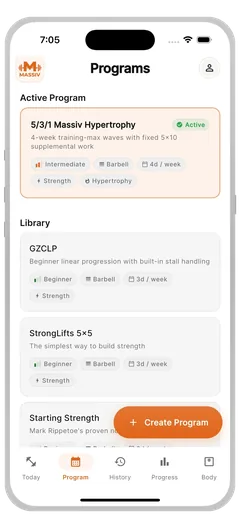
Massiv runs your program’s progression for you, on your phone and your watch. Download Massiv and put it to work in the gym.
Download Massiv →If you want the lowest-friction free logger, Hevy is the easy pick. If you want the app to think for you, Fitbod. But if you run a real program and you’re tired of being its accountant, the app you want is one that runs the plan and grows with you — and brings your history along when you switch.