 MASSIV
The Antagonist Split: Chest With Back, Shoulders With Arms

An antagonist split groups opposing muscles into the same session — chest with back, shoulders with arms — so that while one is working the other is recovering. Run over six days it trains every muscle twice a week at high volume, which is why it became the signature Golden Era bodybuilding structure and is still widely called the Arnold split. Massiv includes a version of it free, with per-exercise progression handled automatically.
What an antagonist split actually is
Antagonist muscles are pairs that pull in opposite directions: chest pushes and back pulls, biceps flex the elbow and triceps extend it, quads extend the knee and hamstrings flex it. An antagonist split puts each pair in the same training session.
The reason is practical. When you finish a set of bench press, your chest needs a few minutes before it can produce force again — but your back is completely fresh. Training the pair together means the rest between your chest sets is doing something rather than nothing, and the session gets denser without getting longer.
There is also a mechanical argument. Working a muscle immediately after its opposite tends to feel stronger, and the local blood flow that produces the "pump" is a large part of why this structure has such a devoted following.
The six-day structure
Three session types, each run twice a week, so every muscle group is trained twice:
| Day | Session | Pairing |
|---|---|---|
| 1 & 4 | Chest & Back | Horizontal push / horizontal pull |
| 2 & 5 | Shoulders & Arms | Vertical push / biceps and triceps |
| 3 & 6 | Legs | Quads and hamstrings |
This is the structure most often attributed to Arnold Schwarzenegger and the Gold's Gym era, and you will see it called the Arnold split almost everywhere. Worth being precise about what that means: Arnold's own training was higher in volume than almost anyone should attempt, and in contest preparation he trained twice a day. The structure survived because the pairing logic is sound. The exact workload did not, and should not.
Who it suits
Six sessions a week is the barrier, and it is a real one. This split asks for six days of gym access, enough food and sleep to recover from high volume, and a training history long enough that you are no longer adding weight every session.
It suits you if you are training primarily for size and proportion, you enjoy being in the gym often, and shorter high-frequency sessions fit your week better than three long ones. It does not suit you if you are chasing a maximal squat or deadlift — the volume is distributed for aesthetics, not for a one-rep max — or if six days is going to become four in practice, because the frequency is the whole point.
A note on supersets
Antagonist pairing and antagonist supersetting are different things, and they get conflated constantly. Pairing means the muscles share a session. Supersetting means you alternate sets back to back with little or no rest between them.
Supersets are a legitimate way to run this split and they make it faster, but they are optional. Doing chest and back in the same session with full rest periods still gives you the recovery benefit. If you are new to this much volume, run it straight before you compress it.
Common mistakes
- Copying the volume rather than the structure. Golden Era routines published in magazines were written by and for people whose full-time job was training. Take the pairing; scale the sets.
- Neglecting legs. Two leg days in a six-day split is easy to quietly turn into one.
- Running it at four days a week. At that point each muscle is trained once and you have a worse version of a different split.
- Adding arm work everywhere. Arms already get direct work twice a week here, plus indirect work on chest and back days.
How Massiv handles this
Massiv's version is Massiv Hypertrophy: Classic Split — six days, the three session types above, and each muscle group trained twice a week. It is included free, along with the other 16 programs.
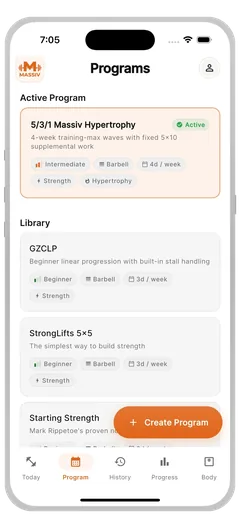
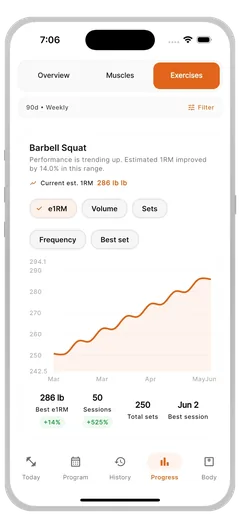
The thing that makes a six-day split painful to run by hand is bookkeeping. Fifteen exercises across three session types, each appearing twice a week, each needing its own weight carried forward — that is a lot to hold in your head or a notes app, and it is why people abandon high-frequency splits long before the training stops working.
Massiv carries every one of those numbers and progresses each exercise on its own increment, matched to the movement rather than applied uniformly. The squat steps by 5 kg, the bench by 2.5 kg, and lateral raises by 1 kg — because a 2.5 kg jump on a 10 kg lateral raise is a 25% increase and would stall you immediately. Every target is then rounded to plates and dumbbells you actually own.
Six days, fifteen exercises, every weight carried forward and progressed on its own increment.
Get Massiv free →Common questions
Is the antagonist split the same as the Arnold split? The Arnold split is the best-known antagonist split, so the terms get used interchangeably. The structure — chest with back, shoulders with arms, legs, run twice over six days — is what people mean. Arnold's actual training volume was far higher than the structure requires and is not a sensible template for most lifters.
Do I have to superset? No. Supersetting antagonist pairs makes sessions shorter and increases the pump, but pairing the muscles in the same session already delivers the recovery benefit. Run it with full rest first, then compress if you want to.
Can I do an antagonist split in four days? Not really — at four days each muscle gets trained once a week, which removes the frequency the split exists for. An upper/lower or PHUL structure is a better four-day option.
A six-day split with the bookkeeping handled. Free on iPhone and Android, no account required.
Download Massiv →The antagonist split earned its reputation honestly: pairing opposing muscles makes dense sessions possible, and six days makes twice-weekly frequency possible. Take that structure, leave the magazine volume in 1975, and it is still one of the best ways to train for size.