 MASSIV
Upper/Lower Split: 4-Day Schedule, Workouts and Progression
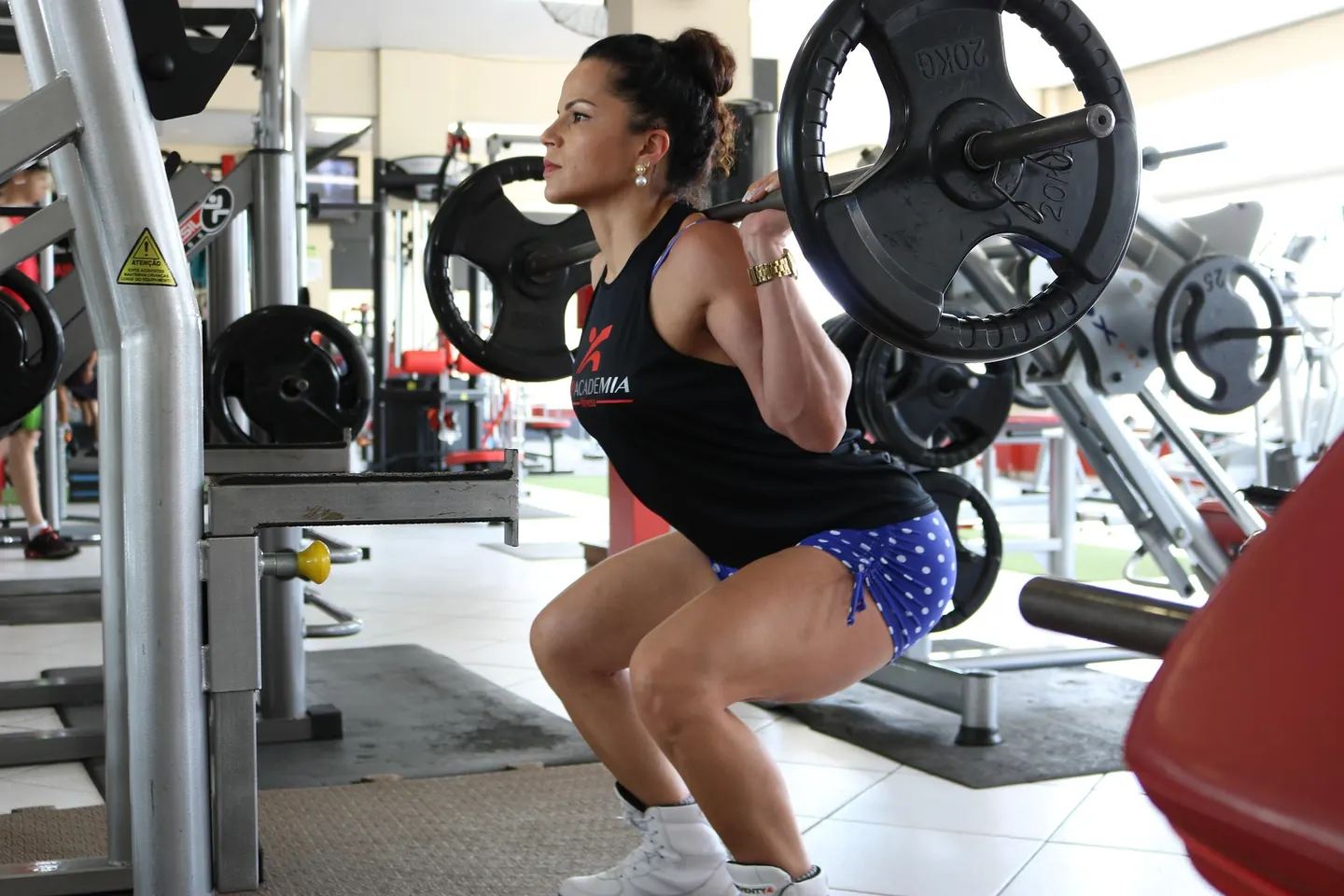
An upper/lower split divides your training into two session types: upper body (chest, back, shoulders, arms) and lower body (quads, hamstrings, glutes, calves). The standard version runs four days a week — upper, lower, rest, upper, lower — so every muscle gets trained twice a week in sessions that stay a manageable length. It suits late beginners and intermediates who can train four days and want one plan that builds both strength and size.
What an upper/lower split is
The idea is simple: split the body in half and alternate the halves. Upper days cover the pressing and pulling muscles; lower days cover the legs and hips. Because each session only has to train half the body, you can do more work per muscle than a full-body session allows, without the session running long.
Most upper/lower programs use two versions of each session — usually called A and B — so the week has some variety. A common pattern is to make the A days heavier (lower reps on the big compound lifts) and the B days lighter with more volume. That is the same idea PHUL formalizes as separate power and hypertrophy days.
- Upper day: a horizontal press, a horizontal pull, a vertical press or pull, then shoulders and arms.
- Lower day: a squat pattern, a hinge pattern, then single-leg or machine work, hamstrings and calves.
Upper/lower schedules: 4, 3 and 2 days
The four-day week is the default because it lines up neatly: two upper days, two lower days, each muscle trained twice. But the split works at other frequencies too.
| Day | 4 days | 3 days* | 2 days |
|---|---|---|---|
| Mon | Upper A | Upper | Upper |
| Tue | Lower A | Rest | Rest |
| Wed | Rest | Lower | Rest |
| Thu | Upper B | Rest | Lower |
| Fri | Lower B | Upper | Rest |
| Sat | Rest | Rest | Rest |
| Sun | Rest | Rest | Rest |
*Week 1 shown. On three days the order keeps rotating, so week 2 is lower, upper, lower.
Four days is the version most people mean, and the one to pick if you can reliably train four times a week. Keep at least one rest day between the two pairs — Monday/Tuesday/Thursday/Friday is the classic layout, but Monday/Wednesday/Friday/Saturday works just as well as long as the order stays upper, lower, upper, lower.
Three days rotates through the sessions rather than fixing them to weekdays: upper, lower, upper one week; lower, upper, lower the next. Each half gets trained three times every two weeks. It is a good fit for anyone whose schedule won't stretch to four sessions.
Two days — one upper, one lower — trains each muscle once a week. It works when life is busy, but each session has to carry the whole week's volume for that half of the body. If you only have two days, a two-day full-body plan is the more common choice.
A sample upper/lower workout
Here is a straightforward four-day template. The A days lead with heavier, lower-rep work on the main lifts; the B days use more moderate loads and more volume. Rest 2–3 minutes on the first one or two lifts of each session and 60–90 seconds on the rest.
Upper A — heavier
| Exercise | Sets | Reps |
|---|---|---|
| Barbell bench press | 4 | 5–6 |
| Barbell row | 4 | 6–8 |
| Overhead press | 3 | 6–8 |
| Pull-up or lat pulldown | 3 | 8–10 |
| Barbell or dumbbell curl | 2 | 10–12 |
| Triceps pushdown | 2 | 10–12 |
Lower A — heavier
| Exercise | Sets | Reps |
|---|---|---|
| Back squat | 4 | 5–6 |
| Romanian deadlift | 3 | 6–8 |
| Leg press | 3 | 10–12 |
| Leg curl | 3 | 10–12 |
| Standing calf raise | 3 | 10–15 |

Upper B — volume
| Exercise | Sets | Reps |
|---|---|---|
| Incline dumbbell press | 3 | 8–10 |
| Lat pulldown | 3 | 8–10 |
| Seated cable row | 3 | 10–12 |
| Dumbbell shoulder press | 3 | 10–12 |
| Dumbbell lateral raise | 3 | 12–15 |
| Curl and triceps extension | 2–3 each | 12–15 |
Lower B — volume
| Exercise | Sets | Reps |
|---|---|---|
| Deadlift | 3 | 4–6 |
| Front squat or hack squat | 3 | 8–10 |
| Bulgarian split squat | 3 | 10 per leg |
| Leg curl | 3 | 12–15 |
| Leg extension | 2 | 12–15 |
| Seated calf raise | 3 | 12–15 |
Swap exercises for equivalents your gym has — a machine press for a dumbbell press, a hip thrust for the Romanian deadlift — but keep one squat pattern and one hinge pattern on every lower day, and one push and one pull on every upper day. That balance is what makes the split work.
How to progress an upper/lower split
An upper/lower split tells you what to train each day. It does not tell you how to get stronger. You add that with a progression rule, and two simple ones cover almost everyone. The progressive overload guide goes deeper on both.
Linear progression for the main lifts
If you are still a late beginner, add a small amount of weight to the main lifts each time you complete all your sets and reps: around 2.5 kg (5 lb) on upper-body lifts and 2.5–5 kg (5–10 lb) on squats and deadlifts. When you miss the target twice in a row on a lift, drop that lift by about 10% and build back up.
Double progression for everything else
For rep ranges like 8–10 or 12–15, use double progression:
- Pick a weight you can lift for the bottom of the range on every set.
- Keep that weight until you hit the top of the range on all sets.
- Then add the smallest jump available and drop back to the bottom of the range.
Small lifts need small jumps. A 2.5 kg increase on a 10 kg lateral raise is a 25% jump; on a 100 kg squat it is 2.5%. Use the lightest dumbbell step or microplates on isolation work so you can keep progressing instead of stalling on the first increase.
Every 6–8 weeks, or when several lifts stall at once, take a lighter week (a deload): keep the exercises, cut the sets roughly in half, then pick up where you left off.
Want the progression handled for you? PHUL, Massiv’s built-in four-day upper/lower program, fills in last session’s weights and works out the next one when you hit your reps. Automatic progression is free for your first 30 days.
Start PHUL in Massiv →Upper/lower vs full body vs PPL vs PHUL
| Split | Days/week | Each muscle trained | Best fit |
|---|---|---|---|
| Full body | 2–3 | 2–3× a week | Beginners adding weight every session |
| Upper/lower | 4 (or 2–3) | 2× a week on four days | Late beginners and intermediates with four days |
| Push/pull/legs | 3 or 6 | 1× or 2× a week | Lifters who can train six days, or want three short sessions |
| PHUL | 4 | 2× a week | Intermediates who want strength and size in one plan |
Full body is the better starting point for true beginners. Programs like StrongLifts 5×5 add weight to the same few lifts almost every session, and that works best when you squat, press and pull three times a week. Move to upper/lower when those workout-to-workout jumps stop coming.
Push/pull/legs groups muscles by movement rather than by half of the body. Run three days a week, it trains each muscle once; run six, it trains each twice. Upper/lower gets you twice-a-week frequency in four days instead of six. See the PPL guide for that side of the comparison.
PHUL (Power Hypertrophy Upper Lower) is an upper/lower split with a fixed job for each session: one heavy power day and one higher-rep hypertrophy day for each half of the body. If you like the upper/lower structure but want the heavy/volume difference built in, the PHUL program guide and PHUL vs PPL cover it in detail.
On frequency: a 2016 meta-analysis of volume-equated studies found that training a muscle twice a week produced more growth than once a week. A 2019 update by the same lead author, covering 25 studies, did not confirm that: with volume equated, frequency made no meaningful difference, and higher frequencies had only a modest edge when they also added volume. The practical reading is that twice a week is a convenient way to fit in enough weekly volume without marathon sessions, not something that grows muscle by itself. Upper/lower does exactly that.
Common mistakes
- Making the upper day a chest day. Match every press with a pull. If your upper session is bench, incline, flyes and a token row, your back and shoulder health will both pay for it.
- Letting lower days shrink. Lower sessions are the hardest of the week and the easiest to cut short. Keep both a squat pattern and a hinge on every lower day.
- Running A and B days the same way. If both upper days are heavy, you get the fatigue of two heavy days and not much extra volume. Give each version a different job.
- Back-to-back lower days. On a four-day week, never put Lower B the day after Lower A. Keep upper and lower alternating.
- No progression rule. Without a written rule and a log, the split just organizes the same weights week after week. Decide how each lift progresses before you start.
- Adding too many exercises. Five or six exercises per session is plenty. If sessions regularly run past 75–90 minutes, cut isolation work before you cut rest on the main lifts.
How Massiv handles this
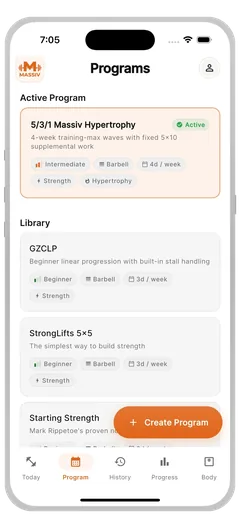
Massiv doesn't have a program called "Upper/Lower". Its built-in upper/lower option for a full gym is PHUL, an intermediate four-day program that rotates four sessions in a fixed order:
| Session | What it includes in Massiv |
|---|---|
| Power Upper | Bench press 4×3, barbell row 4×3, incline bench 3×6, pull-ups 3×6, skull crushers and barbell curls 3×10 |
| Power Lower | Squat 4×3, deadlift 3×3, leg press 3×8, leg curl 3×5, standing calf raise 4×10 |
| Hypertrophy Upper | Incline bench 3×10, dumbbell bench 3×12, cable row 3×10, pulldown 3×12, lateral raise 3×15, then pushdowns superset with cable curls 3×12 |
| Hypertrophy Lower | Squat 3×10, Romanian deadlift 3×10, leg press 3×12, then leg curls superset with leg extensions, seated calf raise 3×15 |
Each exercise has its own target and its own weight step — 5 kg on the power-day squat and deadlift, the leg press and the standing calf raise, 2 kg on lateral raises, 2.5 kg on most of the rest. When you complete the prescribed reps, Massiv raises that exercise by its step and rounds the new target to the plates and dumbbells you've told it you own. The power and hypertrophy days progress on separate tracks, so a heavy triple and a set of ten never share one number.
If you train without equipment, the Advanced Bodyweight Split is also a four-day upper/lower plan, built on pull-ups, dips, pistol squats and nordic curls. And if you want the generic template from this article instead, you can build it yourself with the program builder in Massiv Pro. Every built-in program is free; automatic progression is free for your first 30 days. Compare them all on the programs page.
Common questions
Is an upper/lower split good for beginners? It works for late beginners, especially once adding weight every session on a full-body program has stopped working. Complete beginners usually progress faster on a three-day full-body plan first, because they get to practice the main lifts more often.
How many days a week should I do an upper/lower split? Four is the standard: two upper and two lower days, so each muscle is trained twice a week. Three days also works if you rotate the order each week. Two days trains each muscle only once a week, so each session has to do more.
Is upper/lower better than push/pull/legs? Neither is better in general. Upper/lower trains each muscle twice a week in four days; push/pull/legs needs six days to do the same, or trains each muscle once a week on three days. Pick the one that fits the number of days you can actually train.
Do I need to train each muscle twice a week? Not strictly. Research that matched total weekly volume found little difference between training a muscle once or several times a week. Twice a week is mainly a practical way to fit enough sets in without very long sessions.
Is PHUL an upper/lower split? Yes. PHUL stands for Power Hypertrophy Upper Lower: it runs two upper and two lower days a week, with one heavy power session and one higher-rep hypertrophy session for each half of the body.
Run PHUL with the weights worked out for you. Massiv tracks every lift across all four sessions and tells you what to load next time. Automatic progression is free for your first 30 days.
Download Massiv →The upper/lower split lasts because it is simple: two session types, four days, every muscle twice a week. Balance each upper day with a push and a pull, keep a squat and a hinge on each lower day, write down a progression rule, and give it a few honest months before you judge it.