 MASSIV
PHUL Program: Full 4-Week Schedule + Progression Rules
The PHUL program — Power Hypertrophy Upper Lower — is a four-day split that does something most programs treat as a trade-off: it trains strength and size in the same week, on purpose, without asking you to choose. Two days are built around heavy compound work in low rep ranges; two days shift to higher reps and more isolation. Run it correctly and both qualities move forward together. This guide covers every session, every exercise, how progression works on each type of day, and the mistakes that quietly blunt the results.
What PHUL is — and who it's for
PHUL splits the training week by both body region and training style. Each session has a clear identity:
- Power days — heavy compounds, 3–5 rep range, long rest periods, maximum load. These drive strength.
- Hypertrophy days — moderate-to-light compounds plus isolation work, 8–15 rep range, shorter rest. These drive muscle size.
The result is that each major muscle group gets hit twice a week — once for strength stimulus, once for volume — without any single session becoming unmanageably long.
PHUL suits intermediate lifters: people who can perform the main compound lifts with solid technique, have outgrown beginner full-body programs, and want a structured plan that builds both the lifts and the physique simultaneously. If you're deciding between PHUL and a straight PPL split, the PHUL vs PPL guide breaks down exactly which one fits your schedule and goals.
The full PHUL program
Run on four days per week with at least one rest day between the power and hypertrophy blocks. The most common layout is Monday / Tuesday / Thursday / Friday, with Wednesday and the weekend off. If your schedule demands it, any four days with adequate rest between them work.
The sessions below are the version built into Massiv. Published PHUL write-ups vary: many use rep ranges instead of fixed targets and put an overhead press and lat pulldowns on the upper power day. Massiv's version uses fixed sets and reps, pull-ups on the power day, and saves the lat pulldown for the hypertrophy day. The structure is the same either way.
Day 1 — Upper Power
The session's job is maximum force production on the pressing and pulling patterns. Work up heavy, rest fully between sets (3–5 minutes on the main lifts), and treat rep quality as non-negotiable.
| Exercise | Sets | Reps |
|---|---|---|
| Barbell bench press | 4 | 3 |
| Barbell row | 4 | 3 |
| Incline barbell bench press | 3 | 6 |
| Pull-up | 3 | 6 |
| Skull crusher | 3 | 10 |
| Barbell curl | 3 | 10 |
Day 2 — Lower Power
Squat and deadlift heavy. Everything else is assistance. Keep rest periods long on the first two lifts; you're not conditioning here — you're moving as much weight as you can with clean technique.
| Exercise | Sets | Reps |
|---|---|---|
| Barbell squat | 4 | 3 |
| Deadlift | 3 | 3 |
| Leg press | 3 | 8 |
| Leg curl | 3 | 5 |
| Standing calf raise | 4 | 10 |
Day 3 — Upper Hypertrophy
Shift the intent entirely. Weights are lighter, reps are higher, isolation work goes up, and rest periods come down to one or two minutes. The pushdowns and cable curls are a superset: one set of each back to back, then rest. The goal is accumulated volume and a full muscle stretch-and-contract through every rep — not demonstrating how strong you are.
| Exercise | Sets | Reps |
|---|---|---|
| Incline barbell bench press | 3 | 10 |
| Dumbbell bench press | 3 | 12 |
| Cable row | 3 | 10 |
| Lat pulldown | 3 | 12 |
| Dumbbell lateral raise | 3 | 15 |
| Tricep pushdown (superset) | 3 | 12 |
| Cable curl (superset) | 3 | 12 |
Day 4 — Lower Hypertrophy
Higher-rep leg and posterior-chain work. The Romanian deadlift and leg curl at these rep ranges add meaningful hamstring and glute volume that the heavy Day 2 doesn't fully provide. Leg curls and leg extensions run as a superset. Take most sets to within 1–2 reps of failure.
| Exercise | Sets | Reps |
|---|---|---|
| Barbell squat | 3 | 10 |
| Romanian deadlift | 3 | 10 |
| Leg press | 3 | 12 |
| Leg curl (superset) | 3 | 12 |
| Leg extension (superset) | 3 | 15 |
| Seated calf raise | 3 | 15 |
How progression works
This is the detail most PHUL guides skip, and it's where people stall. Because every exercise above has a fixed target rather than a range, one rule covers both day types.
Hit every rep, then add weight
When you complete every prescribed rep on every working set, add a small amount of weight the next time that exercise comes up — 2.5 kg (5 lb) on most lifts and 5 kg (10 lb) on the power-day squat and deadlift, the leg press and standing calf raises. If you miss reps on any set, keep the weight and try again next time. If the same exercise misses three sessions in a row, take about 7.5% off it and build back.
Running it with rep ranges instead
If you run a version with rep ranges, such as 8–12, many lifters use double progression on the hypertrophy days: stay at a weight until you hit the top of the range on every set, then add load and climb again from the bottom. That's a sound way to run PHUL by hand, but it isn't how Massiv's built-in version works.
Whichever rule you use, the two days still serve different functions. Power days need enough weight that even a small increment is a genuine challenge. Hypertrophy days need enough volume and cumulative fatigue across the week that the muscle actually has reason to grow.
Common mistakes
Going too heavy on hypertrophy days. The most common PHUL error. Hypertrophy days at 8–12 reps should feel distinctly lighter than your power-day work on the same movement pattern. If you're grinding 6 ugly reps "for hypertrophy," you've missed the intent entirely.
Rushing rest on power days. Heavy sets of 3–5 require 3–5 minutes between them. Cutting to 60 seconds because you feel fine turns a strength session into a conditioning session — your top-end loads will drop and strength won't develop.
Skipping Day 4. Lower hypertrophy day often feels like the least glamorous session. It's also where a lot of the quad and hamstring development comes from. People who skip it consistently end up with lagging legs and imbalanced lower body development.
Adding too much assistance volume. Day 3 already has seven exercises. The temptation to add calves, extra arms, or core work to every session turns recovery into the limiting factor instead of training quality. Run the program as written before making additions.
Changing exercises every few weeks. PHUL works through progressive overload on the same movements. If you swap exercises before the weight on them has gone anywhere, you're just burning time. Stick with each exercise for at least a full 8-week block.
How to run it in practice
The canonical week: Monday (Upper Power) → Tuesday (Lower Power) → Wednesday rest → Thursday (Upper Hypertrophy) → Friday (Lower Hypertrophy) → weekend off. The two rest days between Lower Power and Upper Hypertrophy matter — your upper body gets used indirectly on Tuesday through posture and bracing, so Tuesday and Thursday need a day between them.
If you can only train on non-consecutive days (e.g. Monday/Wednesday/Friday/Saturday), that works — just keep the order the same: Power Upper, Power Lower, Hypertrophy Upper, Hypertrophy Lower.
Session length: power days typically run 60–75 minutes at a proper pace (rest periods are long). Hypertrophy days run 75–90 minutes because of the higher exercise count, especially Day 3. If either is consistently running over 90 minutes, you're resting too long on hypertrophy days or socialising too much.
A good PHUL block is 8–12 weeks. At the end of a block, take a light deload week (halve the volume, keep the weights), then start the next block with the weights you left off at. Repeat until progress stalls consistently across multiple lifts — at that point either run another block with adjusted starting weights or rotate to a different split for a change of stimulus.
How Massiv handles this for you
PHUL is straightforward to understand and genuinely fiddly to track by hand: four different sessions a week, with every exercise's weight moving on its own. Massiv ships PHUL as a built-in program and keeps that straight for you. It loads today's session with each exercise's sets, reps and target weight, and runs the supersets on the hypertrophy days. Lifts that appear on both day types — the squat, incline bench, leg press and leg curl — keep a separate weight on each. The hypertrophy version starts at a set fraction of the power-day weight (82.5% for the squat and leg curl, 90% for the incline bench and leg press), so the 3×10 hypertrophy squat runs lighter than the 4×3 power squat, and from there it progresses on its own. After every workout it applies the rule above to each exercise: complete every rep and the weight goes up next time; miss three sessions in a row and it resets about 7.5% lower (5% on lateral raises).
Automatic progression is free for your first 30 days; after that it is part of Pro, and you can keep running any program manually without it.
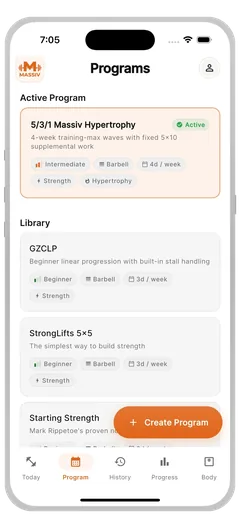
Massiv runs the progression math for this program automatically. Download Massiv and put it to work in the gym.
Download Massiv →PHUL works because it stops treating strength and size as mutually exclusive goals and gives each a dedicated place in the same week. Run the power days heavy and patiently, run the hypertrophy days with honest effort and a full range of motion, and let the two stimuli compound over a proper block. The program is well-designed — the most common reason people don't get results from it is not running it long enough or cleanly enough to find out.